Showing posts with label printables. Show all posts

Friday, 3 November 2017

Oral Communication Activity: Les montres

Its tricky finding ways to get early Core FSL students (Grades 4 and 5 in this case) to speak to each other in French.  That's why sometimes I get students to make props to facilitate those conversations.

One of the lessons we were working on was telling time in French.  We did a few lessons learning about the clock and how to tell time from both analog and digital faces.  Then to practice, we did this activity I call for students to have authentic conversations in French.


For the first part of the activity, I had students make a faux-lex watch (a joke they found very hilarious. Every old can be new again...) Each student got half of this page; they coloured and decorated it, and wrote a time on the face.  Then they cut it out and voilà!... a fake watch to use.

Then students walked around the room asking each other the time.  A conversation went like this: "Bonjour (nom)!  Quelle heure est-il?"  "Il est six heures"  [The student writes down the time on their tracking sheet] "Merci beaucoup! Au revoir!"  And the student found another person to talk to until their page was complete.

And that's the activity!  Students really enjoyed making their watches, and talking to each other.  They were really proud that they could have a conversation in French.


Here is what the worksheet looked like:


Want to try it in your class?

If you are interested in downloading a PDF to use in your class, you can find the worksheet here

...and the watch reproducible here.

How do you get students to practice telling time in your class?  What activities have worked for your students?

Wednesday, 10 August 2016

CEFR Practice Centres


I use the CEFR to guide my teaching practice, quite a bit.  And even though many of the elements included in the CEFR are practiced through my own lessons, sometimes students need some extra time to fine tune their confidence and abilities in these skills.  Most of my student fall into the level A1 category, a beginner speaker who needs highly structured interactions with a fair bit of support.

Some of my grade 8s are approaching a level A2, still a beginner, but with a little more skill and confidence to converse in French, still with some support and preparation.

In order to give them a little more independent practice, I created some practice centres using the amazing and free resource found here.  This document was created for FSL teachers in Ontario, when we were just beginning to use the CEFR to guide our practice in earnest.  Not only is the explanation of how and why using the CEFR is a great idea, there are resources for level A1 included in the doc.

I took the resource, and printed it out in color, and then created practice centres by separating the activities and housing them in page protectors in a box, so students can grab an activity and go somewhere to work on them.


Above is an example of a reading practice activity.  Students take the cards out of the bag and have to match them to a headline.  To assess this skill, I cut up a real French newspaper and magazine, and the students had to match the headline to the photo.   To make the centre, I printed out the descriptors from the online package, printed the graphics from the package, and I made a quick cover for the centre to show students the expectations of the activity.  I made the covers to help students choose centres at their level.  


Most of the activities are meant to be done in partners with and interviewer and an interviewee, so students got a chance to be both roles, but there are a few that can be done individually.


For the partner activities I created peer evaluation sheets, so that students could give constructive feedback to their partners.  Students kept that feedback to give to me when assessing them, and I could see if they used the feedback to improve.  It was a great tool.


For the writing activities, I laminated some postcards and greeting cards I bought that were in French.  Students then wrote their notes in wet erase marker, documented their writing in a photo and sent it to me and their partner for feedback.  Then they erased their card, and it was ready for another student.

The students enjoyed the activities, and got some good practice doing them!  I will be using them again this year!  (If you are interested in any of the handouts I created for this activity, contact me and I can post them. )

How are other ways you use the CEFR to guide your teaching practice?

Tuesday, 22 September 2015

Song: En Classe Je Parle Français- All about that Bass Parody

I have decided, that this year, I want to be the "Weird Al" of French Teachers.

So to kick that off, I wrote some lyrics to go with the song "All About that Bass" that enforce speaking French in class.  Would you like to hear it?


Fun, huh?  I'm teaching in to my classes now, and hopefully they will create a music video in the future for it.  If you want to use it with your classes, feel free!  Here are the lyrics:

If you wanted to sing along to it, you could find a karaoke track on YouTube like this one, but minimize the screen or don't show it, so the students have to use the French lyrics!

If you do use it, and make a totally cool music video, please share it!  I would love to see it!

Monday, 9 March 2015

Les notes visuelles/ Sketchnoting in FSL Part 2

As a sort-of bridging unit, my class and I learned a bit about the value of sketchnoting, and how to start the process.  As a class, we found out that sketchnoting is counter to the notetaking we've been taught for most of our education, so we have to learn step-by-step about creating visual notes.


We looked at the major themes in sketchnoting: 5 elements of drawing (les 5 éléments), creating personalized icons (les îcones), containers (les cases), people (les personnes), and structure (la structure). For each section, we had a brief lesson and then a lot of practice using some of the worksheets I created.

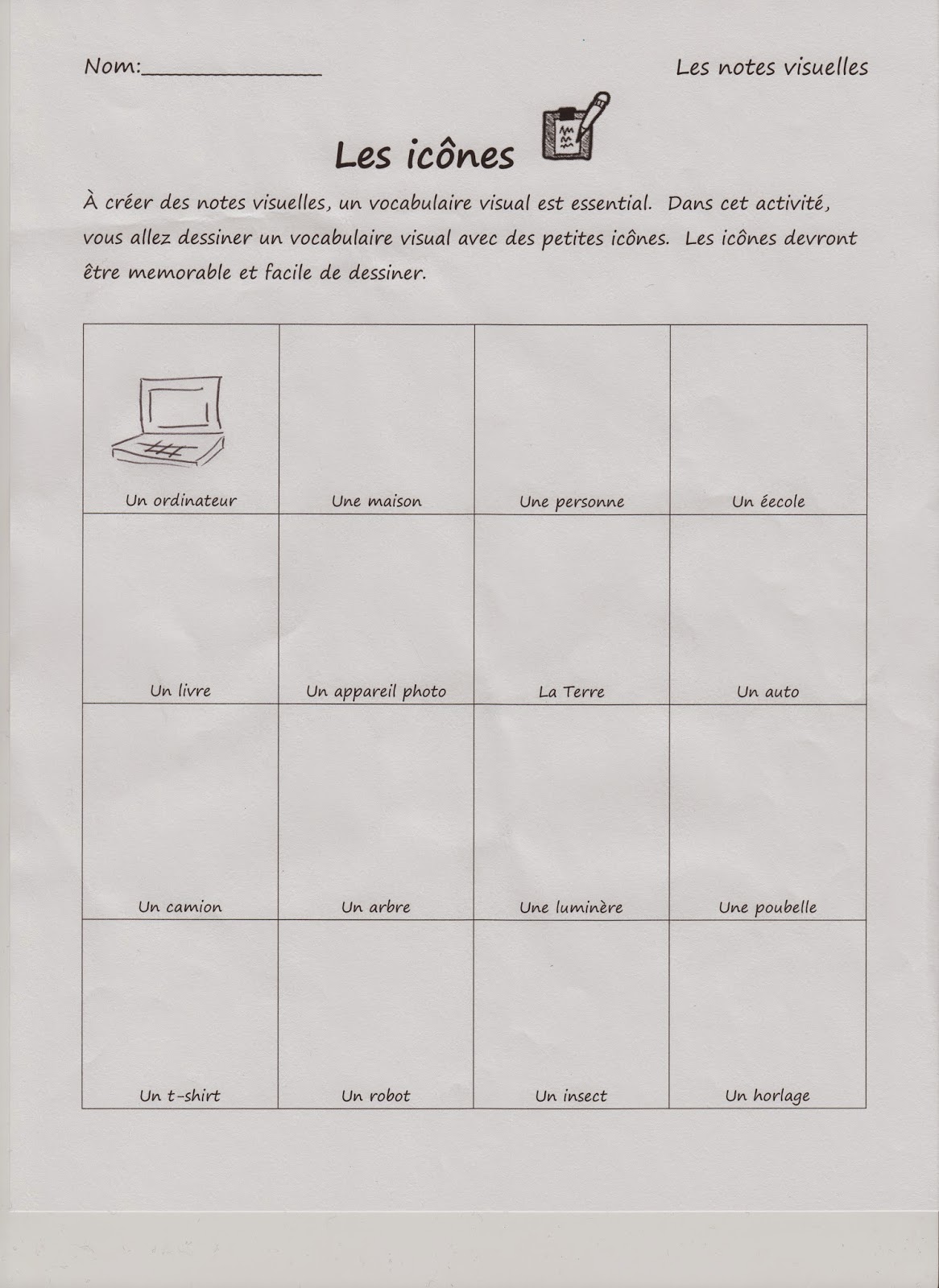
 Here's an example of the worksheet we used to create our personal icons.  What we learned is that sketchnoting is about replacing some parts of our written language with a more visual one.  In order to be successful at that, you need to have a visual vocabulary ready so that those substitutions can happen almost automatically.

To get us started, we created a visual vocabulary for the words and ideas we thought we would use most often.  the goal was to make these icons simple and memorable so that when we heard these specific words, we would recall our icons and use them instead of the words.

To help my students understand what an icon is, and why we would use them, I created a short video for the students to watch about "Les îcones":


Our final activity looked at structure.  I think that this is the most difficult part of sketchnoting.  In order to choose a structure, one has to recognize the patterns in the speakers presentation.  To keep things simple, I taught my students about 7 structures that one can use for any sketchnote without recognizing the structure of the presentation.  For this acticity, students had to either retell their day, or choose a story and retell it through a sketchnote.  Here is the example I made:

 
Students were to use all of the elements of sketchnoting that we learned.   Now that we have moved onto researching about La Francophonie, my students are using sketchnoting to record some of the information they find.  The sidebar we took to explore sketchnoting has been really helpful to my students.  I even use it more in my personal notetaking and found it helps me tackle difficult concepts.  If you are interested in using some of the worksheets I have made, help yourself!

******************************************************************************
Click on the links below to go to a downloadable PDF of each worksheet:


5 éléments worksheet

Les îcones worksheet

Les cases worksheet

Les personnes worksheet

La structure worksheet


Friday, 23 January 2015

Les notes visuelles/ Sketchnoting in FSL

Time flies when report cards are due!  I've been trying to keep up with my assessments and marking, and so my blog here has fallen by the wayside for a while.  But I'm back, and I excited to write about my newest hook for my French students!

While I was marking my students' work, I noticed a trend (that I did not like at the time:)


My students are doodlers!  One part of me was disappointed, because I had these great Oral Communication based classes, that I thought were engaging and fun.  Seeing that the students wanted to doodle instead of listen was frustrating.  On the other hand, I thought about why my students doodled-- sometimes it helped them focus their listening.  For others I think it was because they are more visual learners.  So, with this information I wanted to find something that could incorporate art/ drawing into the class in a way that would make their doodling purposeful and effective to their learning.

With research, I found out about Sketchnoting.

I've read about the trend in English speaking classroom using Sketchnoting to help students make notes of things they hear and read.  I've always been a visual note taker-- it helps keep me engaged.  I didn't know that there was a name for it specifically until I saw Mike Rohde's The Sketchnote Handbook.  I bought it, and did some research online, and there were some English literacy teachers that started using it with their students.  (Some helpful articles I found on Sketchnoting for Education are here, here and here.)  Why couldn't this work for my FSL students?  It would be a visual way of taking those dreaded grammar and vocab notes.

While I noticed there were teachers that used Sketchnotes in their lessons, there were not many FSL teachers that did so.  So finding some resources to use in FSL class was difficult.  But, since I'm a visual learner, and a creative-type, I wanted to make some of my own resources.   To introduce the concept to my students, they were to watch the video by Claudine Delfin about Sketchnoting.


Although the video is in English (I couldn't find any French videos), the students got the basics of the purpose and theory behind using visual notes.  For our first lesson, we watched the video, and then had a PCP ( Pensez/Couplez/Partagez) discussion about the important points of the video in French.  As we shared what we thought were the important points, we created our own "note visuelle" about the video.  I created on at the front of the class, and the students were welcome to copy mine, or think of their own imagery to support their points.

As we did the notes, the students were engaged with the discussion and with creating their doodles to support their note.  Some of my most challenged students were creating great notes visuelles:


While students were waiting on the next point during discussion, they added details to their doodles, shared them with each other.


The next class, students were asked to review their notes, and share which points we had already covered, so we could continue the note.  Many students were able to form simple sentences to convey their points from the class before.  More, students commented on how much they enjoyed the process of learning how to make these visual notes.  In order to support the students' learning, and maintain French as the language in FSL class, I created a couple of "notes visuelles" in French.  I photocopied them, and distributed them to the students.  This first handout is based on a page that educator CarolAnne Maguire created in English.  I loved it, so I drew a  French version (Click link for printable version:


Our first grammar based "note visuelles" was a review about our articles:


The above note I used my iPad to create.  For my student that use assistive technology, I was able to teach them how to create their NVs on their devices. 

This is an exciting project that my students and I are doing together.  As I make more resources, I will post them.  And if you start this with your studnets, I would love to know how it goes!

Would you ever try sketchnoting in your FSL class? 

Tuesday, 16 September 2014

La rentrée: Sur mon iPhone

I was thinking of different activities I could use to get to know my students at my new school.  Instead of having them write a paragraph about them, I wanted something they could do a little more independently, and something that was creative.  After seeing a technology-themed bulletin board idea, I thought of this activity:


Students get a blank iPhone template, and they have to create icons of things that they like.  For my example, I drew a "creeper" from Minecraft and labelled it "les jeux vidéo." The students had to draw 12 icons, and I hope to use the iPhones in a display outside the French office.

*********************************************************************************

If you are interested in doing this activity yourself, here's the handout (link) I made.  There are 2 phones per page, trying to save some trees.

Sunday, 20 April 2014

On Managing Assessment

My assessment management tool in action
When I talk to other French teacher, the thing we seem to struggle most with is organizing our assessment.  I think most FSL teachers have a handle on what they want to assess, but organizing that for sometimes hundreds of students is daunting.  It was for me, anyways.

Still, one thing that I am always struggling with is capturing an accurate view of my students' progress.  More than that, as a newer teacher, I couldn't keep all the expectations in my head.  In French class, a lot of my planning of activities include the expectations-- but often, I am assessing spontaneous conversations, so it is important for me to have quick access to the expectations, and their relation to the Achievement chart (A-Chart). 

Many veteran teachers shared with me that they use a class list to record and track their students' progress.  I thought that was a great idea, but I did not have the confidence that I would remember exactly what I was assessing for, being new to the FSL curriculum.  I decided to try and create a tool that works for me for Assessment purposes.  I knew that I would have to create a cheat sheet to help me track the curriculum expectations that I would need to teach.  So, I came up with this:
  
Click the picture for a larger view


My assessment tool is 2-sided, I couldn't get away with one page.  On the one side is a table that includes my class list, a section to record what activity I am marking, a breakdown of the grades I use and a section for the assessment "codes." 


The back of my sheet is a "Cliff notes" version of the FSL curriculum for the grade I am teaching.  This is an example of the grade 5 FSL curriculum that came out recently.  Each of the expectations are bundled and organized according to where I felt they fit in the Achievement Chart (Page xx-xx).  I like the way the new curriculum is organized, it makes fitting each expectation into the chart easier as the expectations are already clustered thematically.  For example, I know that all "3.1" expectations have to do with French culture and contributions to the world.

The "code" I use on the front, are based on the heading of the A-Chart, with a number for the order on my chart.  The expectations and their strands that fall under that section in the A-Chart are below my "codes" bundled.  I know that if I am assessing an oral activity, that something "coded" "C1" or Communication 1 covers the expectation B 1.2 or B 1.3, because I note which strand the expectations belong to beside the expectation number.

Throughout the term, I can look at the tool, and note which expectations I am missing, and therefore what I have to teach.  The bottom of my second page helps me plan my activities.  I made sure to copy some of the teaching strategies and suggestions from the curriculum on my tool, to help me plan meaningful and expectations-based activities. 

I find that having the expectations handy while I teach is useful.  At-a-glance, I can see which expectations my students excel at and struggle with, and this informs my planning.  All in one place!  What do you use to manage your assessment data?


If you are interested in downloading a copy of my Assessment tool to try and create one of your own, click here.  If you are interested in me sharing an editable version of my tool, please let me know in the comments, and I will upload it once I get to my school computer!

Saturday, 15 February 2014

Writing Activity: Mon Caractère

Writing activities are usually an ordeal in FSL class.  My students have specific challenges in writing in English, as well as French.  As a result, I find that I have to be very strategic in creating writing activities for my students.

This activity/ project that I came up with was meant to be a bridging activity between the focus questions from our last unit "Je me présente," to our new focus around "Les bandes-dessinées."  Before we started this activity, we learned the third-person singular of the verbs "to be" and "to have."  We learned how to apply the questions of "Je me présente" to other people.

To engage their interest in writing, I thought that it would be fun to create cartoon characters and write about them.  I found these great drawing sheets while browsing Pinterest, and thought they would be perfect to help the kids create their cartoon.

They loved the drawing part.  I encouraged them to create silly characters-- characters that they would want to write about.  Some didn't even use the books.  The example that I created was a Viking-turned-father named "Sven."

I created the example as a way of modelling the writing we were going to do.  I made sure that I followed the Gradual Release of Responsibility model here because writing in French is fairly new to my grade 4s.  We read the paragraph about "Sven," and the students thought it was funny.  We looked at the structure of the paragraph they were to write.  Built into the activity, were questions and prompts to remind the student to write in complete sentences.  I worried about being so rigid, I wanted to students to be creative with their writing, but I wanted them to feel confident that they could write a paragraph in French.

During the modelling part of the lesson, I made sure that the students knew that they would have to bump-up their paragraphs by adding 2-3 original sentences.  We added some to my paragraph together.

For the next step of the activity, we created a paragraph through a shared writing activity.  I drew a  large version of a cartoon on some chart paper, and using the prompts, as a group we wrote the paragraph.  Because my students needed a little extra practice to build their confidence, in small groups we did a second shared writing activity.  Then each group shared their paragraphs.

For the last step, students drew their cartoon and wrote a paragraph about them.  Students really enjoyed this project.  They liked that the drawing books I had made for them helped them draw something they were really proud of.  Their paragraphs were creative, and well written!  And many of my students could write them independently.  I liked that they were working independently in FSL class-- this is a rare occurrence.  Until recently, my students have not had the confidence to complete something without assistance in some way.  I was able to work with small groups of students who were having trouble.

Here are some examples of the work my students created:

To read the paragraphs, click on the image for a larger version.


This was a great writing project for my students.  They were really interested in each others work, and we did several gallery walks after we were finished.  

To add an oral component to it, I'm thinking of having the students interview each other about their characters.  We have a great article which is an interview with a real cartoonist in our books (Acti-Vie 1: Les aventures d'A-V).  We will record the videos on our ipads.  I will let you know how those turn out!


Here are the materials I used for this activity.  I copied 20 drawing booklets for drawing the characters.  I put them in duo-tangs so that we can use them again.  

Saturday, 25 January 2014

Oral Communication Strategy: Qui Suis-Je?

Qui suis-je in action with one of my Grade 4 classes.
This week I introduced a new strategy to my students.  Right now we are working on the CEFR focuses (foci?) of "Je pose des questions,"  and "Je decris les personnes and les places."  I thought a good way to bulk up their vocab for description, and get them used to asking questions was to play Qui suis-je?, a game not unlike the game "Headbandz."  There was quite a bit of preparation for students to get the the independent practice level in this game.  We played this game for a while as a class, and the shared practice was something that the students really enjoyed.

Anchor charts for support
In order to set my students up for success, the preparation for this game was pretty involved.  I had created anchor charts that had pictures of celebrities, and asked questions about a personality.  We created the questions as a class based on the anchor chart of celebrities that I introduced first.  One lesson that came out of this game was the mini lesson I had to teach on inversion and intonation. The students grasped the concept pretty readily-- they made great connection.  One student noted that we use the question "comment t'appelles-tu" and asked if that was inversion.  It was a great mini-lesson!  

After we created the list of questions, I created a scorecard for the students to use: not only to organize their thinking, but to get them reading the questions without the support of the images I added for comprehension.  The scorecard was a table that I filled with the questions, and a box to check or "x" depending on the question and answer.  We had 2 answers for the grade 4 classes (Oui ou non), and 4 for the grade 5s (oui, non, peut etre, et parfois.)

For the "headbands," I used some dollar store sunglasses with velcro dots attached to them.  Then each of the pictures had velcro on the back so students can swap the pictures in between turns.   

Glasses  instead of headbands.  We have a critter problem at our school .
The shared process was fun for the class.  I modeled one turn, by having the students pick the picture for my glasses.  I modeled how to use the scorecard on a giant version that I created for modelling.  There were only 12 pictures to choose from, so all the images were hanging up for students to consult.  We played a class version of the game each class for a while.  Until the students were really used to the questions.  Some students started creating their own yes or no questions, which was fabulous!  

When we moved to the independent practice, students played the game in groups of 4 or 5.  There was quite the buzz in the class, students were really enjoying it!  While the students played the game, I circulated and assessed their progress.  

Again, it was great to see the students using gestures, and other speaking strategies that they had learned earlier in the year!

Scorecard for student book
The great thing about having created this game is that I can use it again when we meet the new characters for our next unit on mysteries.  I have some grand plans for that unit! 

I have used post-it notes to play a version of this game with some of my older classes.  I opted for this picture-based version for my younger students to ensure a level of success.

See the bottom of the post for download links to my resources!


If you would like to make your own, here are the files that I made for the game.  Feel free to download and print!

Celebrity cards: (I printed two sizes, 1 collage per page for the anchor charts and 2 collages per page for the playing cards.) Download here (page 1). And here (page 2).

Scorecard worksheet: I printed it for the students to consult when they played and to track their thinking. Download here (PDF).

Wednesday, 15 January 2014

Fixed links on Printables page

Hi!  I got a few emails asking my to share some documents on my Google Drive.  I had thought I did, but it turns out I forgot to check the box to share.  Now, I've fixed it!  If you have the link, you should be able to download any of my strategy cards and resources.  Sorry about the inconvenience!


Wednesday, 8 January 2014

Updated Printables Page

I got a few emails asking me for the files for my speaking strategy cards that are in the photo from this post.  No problem!  I added the link to download your own on my "Printables" page here or follow this link to download them.  I also added a link to some cards I made for listening strategies.  They are also on the "Printables" page, or download them right this way at this link.

And, a BIG thank you to all the nice emails I got about my blog.  I was not sure if this would be of interest to anyone, but I got such encouragement!  Thank you again!


Monday, 6 January 2014

Les stratégies- Explicitly Teaching Strategies in Class


Click on pic for larger image
I am always looking for ways to improve my students' confidence when it comes to understanding and using French.  Convincing my students to speak in French has been one of my biggest challenges this year!  I explicitly teach/taught/am still teaching some strategies for comprehension, speaking and reading to help my students navigate the many parts of speaking French, and to build their confidence in understanding it. I did not makeup these strategies; I learned them from my mentor.  I thought they were great, and set off using them right away!

Currently in my class, we have been focussing mainly on the "stratégies de comprehension."   I started at the beginning of the year, teaching the first five on the list (Je regarde les image/ I look at the pictures; Je cherche les mots-amis/ I look for cognates; Je cherche les mots-connu/ I look for words I know; Je lis la salle de classe/ I read the classroom; and J'infere/ I infer.)  I added at the beginning of the year  "J'utilise le dictionnaire/ I use the dictionary" because I thought that was an important skill to learn right off the bat.

I think they are great tools.  I have the same pictures and words hanging in my classroom, and in the students' homerooms as well.  I refer to them constantly.  We have used them explicitly in most of our activities.  But, the students still do not use them on their own.  They know all the strategies and what they mean.  And they can use them when I tell them to.  But they are not making the connection to use them on their own.  How do I get them to that level?  This is a new challenge for me.  When I taught these strategies in the past, the students used them frequently and without being told to do so.  My current students do not, which means I need to change something to encourage them to use these strategies.  My goal is for these students to use these tools on their own without my direction.

I found an article on Edutopia about helping students to become "deeper listeners."  This got me thinking about how have I been encouraging my classes to be active listeners. I had not taught active listening explicitly.   When I spoke to my colleagues about this question, they agreed that our classes have a difficult time listening, actively or otherwise.  Active listening hadn't been taught explicitly in their homeroom either; so one strategy I want to try is based around this idea. I would like to use the Think-Pair-Share (Pensez-Partenaires-Partagez ?) strategy in FSL class.  Students would speak about a text they had listened to, collect some information about what they needed to listen for, and how they had understood or misunderstood it.   I would have to prepare some vocabulary for this activity, but I think that it would be valuable to practice active-listening.  This activity would be very short: 3 minutes listening, 3 minutes in partner discussion, and 3 minutes in sharing.  I want it to be short so we can do this activity often.   What activities do you use to encourage active listening?

With this in mind, I believe that I may have to do more work with metacognition in my classes.  This creates a new set of challenges, because speaking about one's own thinking is difficult in one's own language.  How do I encourage students to reflect on their learning when their vocabulary is so limited?   One strategy that I want to use is an "exit ticket" for students to complete at the end of the class that deals specifically with student learning.  I want to give them time to think about their learning process, and the challenges that they may have.  Another strategy that I have used in the past and may fit here, is using sentence stems that help students form their thoughts on metacognition in French.  What do you think?


I don't mind sharing either!  If you would like to print out my strategy cards for your own use, please do!  I have them hanging up in the class, and I carry a set on my cart for traveling purposes.  Click on the link below for a PDF of the comprehension strategy cards.  I hope you find them helpful!

Comprehension Strategy Cards:
https://drive.google.com/file/d/0B11PNgL_hdjrbE81WjhjS1VxeGs/edit?usp=sharing