Showing posts with label writing strategies. Show all posts

Friday, 23 October 2015

Warm-up/ Review Activity: Décrivez-moi!


Here's a quick activity that I did with my grade 7 and 8 classes, that got them speaking some French to each other, and reviewed adjectives with them too.  I call it "Decrivez-moi!" and it was a lot of fun.  One of my grade 7s actually said at the end of class "Thanks for the fun class today Madame."

It is very simple to set up.  If you want to use my worksheet for adjectives, here's the link

Instructions:

1.  Each students needs a piece of paper and a pencil or marker.  Markers make a pretty sheet, but pencils work fine too.  My students just used their pencils.  Have them sit around a table in groups of 4-6 students.  Smaller groups are less confusing when the activity starts.  They may also need a list of adjectives to consult. 

2. Make sure the students write their name at the bottom of the page, so they can find their page at the end. 

3. Use an interval timer for 30 seconds like this one on YouTube to mark the time for each turn.  When the timer starts, students pass the paper they have to the left.  They will receive a paper on their right.  In the 30 seconds, they must write one adjective that describes the person who's paper they have.

4.  Once the 30 seconds is up, they pass the sheet on, and get a new one to write on. And so on.

5.  When students get their own paper, they can add one, or take a 30 second break to see what others wrote.


I do this activity until each student had at lease 15 adjectives on their page.  About 6 minutes or so.  When the students get their paper back, they are to circle the adjectives with which they agree, and "x" out the ones they don't agree with.

During the activity, students would tell each other "Vite!" and "Changez!" "le cloche va sonner!" and "Passez le papier!" while they were playing. I added an assessment by asking each of the students about the adjectives on their page, and with which they did and didn't agree.  Boom.  Authentic conversations.

If you don't want to use adjectives, I think you could adapt this for other vocabulary review, by having the students work in teams until they have added every word that need to be covered.  Or use it for creative writing in Immersion by having the students write one sentence to create a team story to share with the class.    

What other ways could you adapt this activity?


Monday, 9 March 2015

Les notes visuelles/ Sketchnoting in FSL Part 2

As a sort-of bridging unit, my class and I learned a bit about the value of sketchnoting, and how to start the process.  As a class, we found out that sketchnoting is counter to the notetaking we've been taught for most of our education, so we have to learn step-by-step about creating visual notes.


We looked at the major themes in sketchnoting: 5 elements of drawing (les 5 éléments), creating personalized icons (les îcones), containers (les cases), people (les personnes), and structure (la structure). For each section, we had a brief lesson and then a lot of practice using some of the worksheets I created.

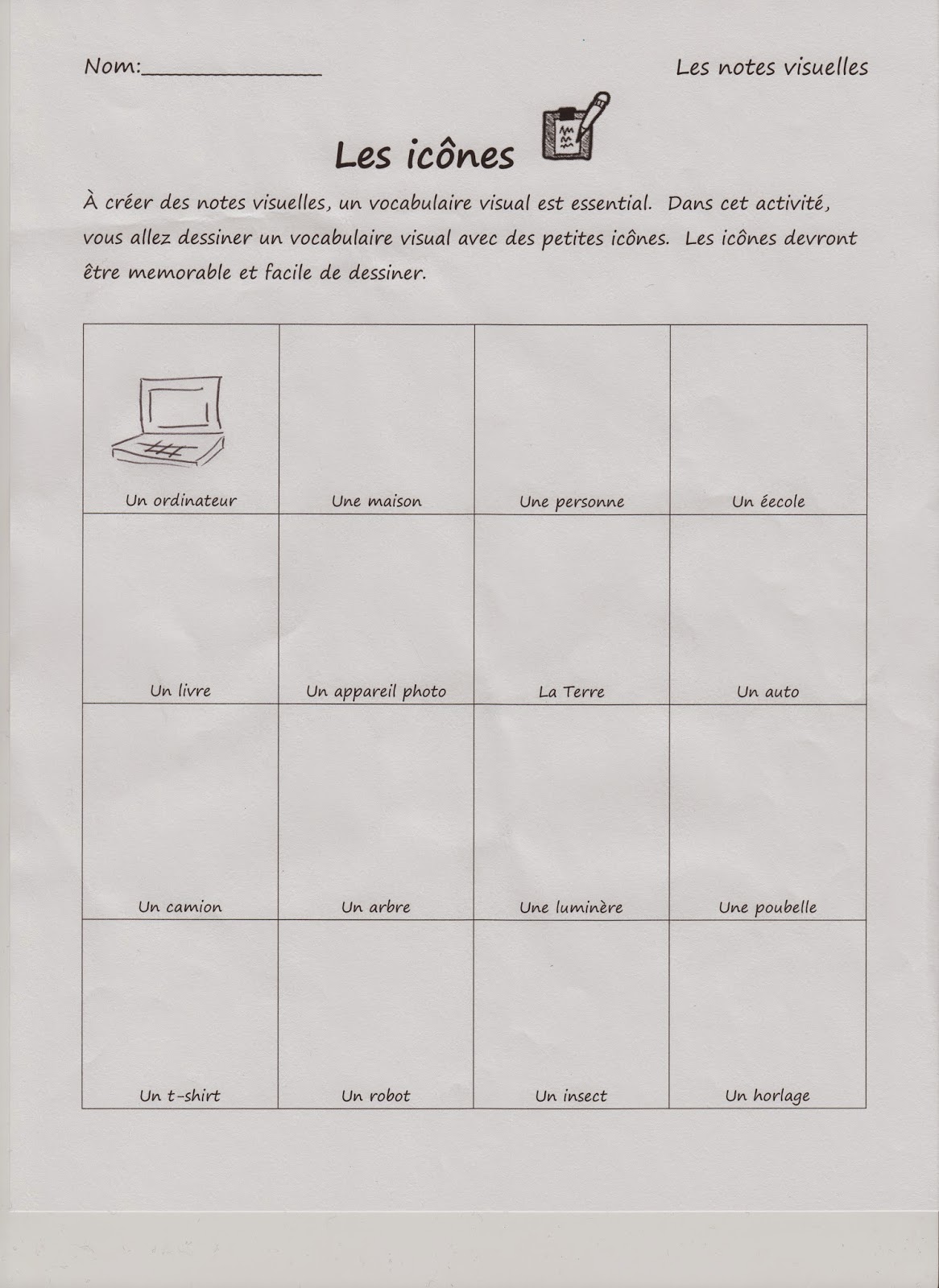
 Here's an example of the worksheet we used to create our personal icons.  What we learned is that sketchnoting is about replacing some parts of our written language with a more visual one.  In order to be successful at that, you need to have a visual vocabulary ready so that those substitutions can happen almost automatically.

To get us started, we created a visual vocabulary for the words and ideas we thought we would use most often.  the goal was to make these icons simple and memorable so that when we heard these specific words, we would recall our icons and use them instead of the words.

To help my students understand what an icon is, and why we would use them, I created a short video for the students to watch about "Les îcones":


Our final activity looked at structure.  I think that this is the most difficult part of sketchnoting.  In order to choose a structure, one has to recognize the patterns in the speakers presentation.  To keep things simple, I taught my students about 7 structures that one can use for any sketchnote without recognizing the structure of the presentation.  For this acticity, students had to either retell their day, or choose a story and retell it through a sketchnote.  Here is the example I made:

 
Students were to use all of the elements of sketchnoting that we learned.   Now that we have moved onto researching about La Francophonie, my students are using sketchnoting to record some of the information they find.  The sidebar we took to explore sketchnoting has been really helpful to my students.  I even use it more in my personal notetaking and found it helps me tackle difficult concepts.  If you are interested in using some of the worksheets I have made, help yourself!

******************************************************************************
Click on the links below to go to a downloadable PDF of each worksheet:


5 éléments worksheet

Les îcones worksheet

Les cases worksheet

Les personnes worksheet

La structure worksheet


Friday, 23 January 2015

Les notes visuelles/ Sketchnoting in FSL

Time flies when report cards are due!  I've been trying to keep up with my assessments and marking, and so my blog here has fallen by the wayside for a while.  But I'm back, and I excited to write about my newest hook for my French students!

While I was marking my students' work, I noticed a trend (that I did not like at the time:)


My students are doodlers!  One part of me was disappointed, because I had these great Oral Communication based classes, that I thought were engaging and fun.  Seeing that the students wanted to doodle instead of listen was frustrating.  On the other hand, I thought about why my students doodled-- sometimes it helped them focus their listening.  For others I think it was because they are more visual learners.  So, with this information I wanted to find something that could incorporate art/ drawing into the class in a way that would make their doodling purposeful and effective to their learning.

With research, I found out about Sketchnoting.

I've read about the trend in English speaking classroom using Sketchnoting to help students make notes of things they hear and read.  I've always been a visual note taker-- it helps keep me engaged.  I didn't know that there was a name for it specifically until I saw Mike Rohde's The Sketchnote Handbook.  I bought it, and did some research online, and there were some English literacy teachers that started using it with their students.  (Some helpful articles I found on Sketchnoting for Education are here, here and here.)  Why couldn't this work for my FSL students?  It would be a visual way of taking those dreaded grammar and vocab notes.

While I noticed there were teachers that used Sketchnotes in their lessons, there were not many FSL teachers that did so.  So finding some resources to use in FSL class was difficult.  But, since I'm a visual learner, and a creative-type, I wanted to make some of my own resources.   To introduce the concept to my students, they were to watch the video by Claudine Delfin about Sketchnoting.


Although the video is in English (I couldn't find any French videos), the students got the basics of the purpose and theory behind using visual notes.  For our first lesson, we watched the video, and then had a PCP ( Pensez/Couplez/Partagez) discussion about the important points of the video in French.  As we shared what we thought were the important points, we created our own "note visuelle" about the video.  I created on at the front of the class, and the students were welcome to copy mine, or think of their own imagery to support their points.

As we did the notes, the students were engaged with the discussion and with creating their doodles to support their note.  Some of my most challenged students were creating great notes visuelles:


While students were waiting on the next point during discussion, they added details to their doodles, shared them with each other.


The next class, students were asked to review their notes, and share which points we had already covered, so we could continue the note.  Many students were able to form simple sentences to convey their points from the class before.  More, students commented on how much they enjoyed the process of learning how to make these visual notes.  In order to support the students' learning, and maintain French as the language in FSL class, I created a couple of "notes visuelles" in French.  I photocopied them, and distributed them to the students.  This first handout is based on a page that educator CarolAnne Maguire created in English.  I loved it, so I drew a  French version (Click link for printable version:


Our first grammar based "note visuelles" was a review about our articles:


The above note I used my iPad to create.  For my student that use assistive technology, I was able to teach them how to create their NVs on their devices. 

This is an exciting project that my students and I are doing together.  As I make more resources, I will post them.  And if you start this with your studnets, I would love to know how it goes!

Would you ever try sketchnoting in your FSL class? 

Saturday, 15 February 2014

Writing Activity: Mon Caractère

Writing activities are usually an ordeal in FSL class.  My students have specific challenges in writing in English, as well as French.  As a result, I find that I have to be very strategic in creating writing activities for my students.

This activity/ project that I came up with was meant to be a bridging activity between the focus questions from our last unit "Je me présente," to our new focus around "Les bandes-dessinées."  Before we started this activity, we learned the third-person singular of the verbs "to be" and "to have."  We learned how to apply the questions of "Je me présente" to other people.

To engage their interest in writing, I thought that it would be fun to create cartoon characters and write about them.  I found these great drawing sheets while browsing Pinterest, and thought they would be perfect to help the kids create their cartoon.

They loved the drawing part.  I encouraged them to create silly characters-- characters that they would want to write about.  Some didn't even use the books.  The example that I created was a Viking-turned-father named "Sven."

I created the example as a way of modelling the writing we were going to do.  I made sure that I followed the Gradual Release of Responsibility model here because writing in French is fairly new to my grade 4s.  We read the paragraph about "Sven," and the students thought it was funny.  We looked at the structure of the paragraph they were to write.  Built into the activity, were questions and prompts to remind the student to write in complete sentences.  I worried about being so rigid, I wanted to students to be creative with their writing, but I wanted them to feel confident that they could write a paragraph in French.

During the modelling part of the lesson, I made sure that the students knew that they would have to bump-up their paragraphs by adding 2-3 original sentences.  We added some to my paragraph together.

For the next step of the activity, we created a paragraph through a shared writing activity.  I drew a  large version of a cartoon on some chart paper, and using the prompts, as a group we wrote the paragraph.  Because my students needed a little extra practice to build their confidence, in small groups we did a second shared writing activity.  Then each group shared their paragraphs.

For the last step, students drew their cartoon and wrote a paragraph about them.  Students really enjoyed this project.  They liked that the drawing books I had made for them helped them draw something they were really proud of.  Their paragraphs were creative, and well written!  And many of my students could write them independently.  I liked that they were working independently in FSL class-- this is a rare occurrence.  Until recently, my students have not had the confidence to complete something without assistance in some way.  I was able to work with small groups of students who were having trouble.

Here are some examples of the work my students created:

To read the paragraphs, click on the image for a larger version.


This was a great writing project for my students.  They were really interested in each others work, and we did several gallery walks after we were finished.  

To add an oral component to it, I'm thinking of having the students interview each other about their characters.  We have a great article which is an interview with a real cartoonist in our books (Acti-Vie 1: Les aventures d'A-V).  We will record the videos on our ipads.  I will let you know how those turn out!


Here are the materials I used for this activity.  I copied 20 drawing booklets for drawing the characters.  I put them in duo-tangs so that we can use them again.  

Saturday, 25 January 2014

Making Music for French Class Again

After I posted about making music for French class, I got some great comments!  Thank you!  One comment asked if I wouldn't mind sharing the "karaoke" version of the song so that other students can try writing their own verses.  No problem!  Great suggestion.  So I have added to the original post the track without my singing, and a copy of my lyrics for you and your students to consult.  Click here to go to the original post.

Thursday, 16 January 2014

Making music for French Class

Students reading my song lyrics to understand the format
I love using music in French class.  The kids love it, and I do too.  Its the one thing that can really get me moving.  My grade 5 classes had completed a short unit on Popular French music.  Some of the songs we discovered are some of the kids' favorites!

Lately, I have been writing my own French songs for the kids to listen to in class.  I wrote one song for our project on Movember; we had some male staff in our school participate this year.  The song was part of a webquest that some students completed.  They loved that song!  For the whole week, they walked around singing "je n'aime pas les moustaches."  They even requested it in their class party!

I thought that I would try again by creating a song for our unit "Je me presente!"  I wanted the song to be simple so that the students would understand it, and so that we could turn it into a writing activity.  Here's what I came up with:


And here is the track sans vocals:


 We started listening to it this week, and we read the lyrics. (Click here to download a PDF of the lyrics.)  The students understood the song very quickly (using their strategies!).  They thought it was funny.  Then I told them that they were going to write their own songs, and they were very anxious.  There were a lot of "I can't"s and "too hards" floating around the place.  The students were adamant that they couldn't.  It was quite frustrating, so we moved onto the next activity.  But I knew that we would revisit the song later.

Today, we listened to the song again, and focused on the structure of the lyrics.  The students noticed that there were many repetitions in the song.  We broke down the song into sections: the chorus, and the verses.  The students were asked to write one verse about themselves.  To help them in their writing, they used their notebooks with all their work from the unit "Je me presente."  Each student had written a lot about themselves already.  They just needed to put it in the right format!

Some student lyrics
 Once they got over their initial fear, they started to write some great lyrics!  They were allowed to used my chorus, and format.  That way it would work when they sang it to the instrumental version of my song.  To get them started, I suggested that they write out the chorus, because its less intimidating than a blank page-- that's what I do.  Many of the students said this helped. And they were writing!  They were talking to each other about song ideas, and trying to find rhyming words for their verses!
It was really exciting for me to see them trying to create their songs.  They were very intimidated about the idea, but as they started, they were adding more ideas.  What we will do is finish our verses, and record our song about our class. 

If you were interested in making your own songs, I will tell you how I made mine.  I use the ipad app Garage Band to make and record songs for class.  Its easy to use, and I can hook up my guitar to it, or use the sounds in the program.  The best way to start is to play around with the app, and find a sound you like.  If you have a friend or child that plays music, they can help too!  I make my husband sing on some of the songs if I need a deep voice.  The resulting song is not bad in quality, or sound.  Its great for class, and you can export the song to other platforms if needed.  For my mustache song, I exported it to Moviemaker, to create a video.
More student's lyrics

If you are not the type to write a song, there are other cool ways to incorporate music and writing into your classroom.  This teacher had his students write the lyrics of the popular song "What does the fox say?" in French.  I had a friend who was in a French children's music group, and they had a contest:  Schools submitted their translations of songs, and then the group recorded it and a video starting the students!  I like to use French Pop music in the activity "Milling to the music" or as we call in in French class, "Marchez a la musique."  Universal France has a great You Tube channel for discovering upbeat modern French music.    
Want to take the plunge and try GarageBand?  This is a great tutorial site if you are interested in trying out the app.  If you make up a song, let me know!  I love finding new french music.  And, as always, you are welcome to use my song in class.  It will fulfill my dream of being a pop star ;-)