Showing posts with label student work. Show all posts

Thursday, 5 April 2018

I wrote a resource! La Francophonie: Haïti

It has been a while since I posted anything of substance on this blog.  Désolée! I have been really busy.  I know, I know... Everyone is busy... but I have been too.  One project that I was working on, and have since finished and now I can share, is that I wrote a resource, La Francophonie: Haiti (ISBN9781554099504)

The lovely people at Tralco-Lingo Fun asked me if I would create a resource about Haïti because information for FSL teachers and students was lacking.  Since my new focus/ obsession is Interculturalism in Core FSL, I jumped at the chance.

I have had a love of the country of Haiti for a while.  I find its history fascinating, and its people amazing and resilient.  So, naturally, this resource definitely comes from that perspective.  The resource is full of activities that I have done with my grade 7 and 8 classes, and touches on the theory of interculturalism; the history of Haiti and the culture, with numerous activities to get your students thinking and speaking!

Here's the description from the Tralco website:

"A chance to learn about something new: a history and culture that most students have not been exposed to in their classes! Haiti. The author has used these activities in her classes. 
Students will glimpse into Haitian culture and make connections to their own culture. Teachers are provided with the necessary background knowledge while student activities provide opportunities to explore this culturally rich former French colony. The activities touch on all four strands of French language learning (Listening, Speaking, Reading and Writing).  
The complex history of Haiti unfolds and includes Haiti from being a slave colony of France to a free state, all in a student-friendly way. Using Google Earth, students will also explore Haiti's geography. They will then delve into into the particulars of the Haitian language, fun folklore, lively music and food with optional hands-on activities. 
A reading activity to exercise critical-thinking will get students thinking: Why is Haiti a poor country? To answer this question, students will have to draw on the knowledge they gained learning about Haiti’s history. There are also lists of resources (websites and online videos) for teacher info to enhance lessons as well as providing opportunities for social justice learning."

If you want to check it out, you can visit the Tralco-Lingo website at www.tralco.com and look at some sample pages.  I could add a sample here.  Would that be helpful? I would love to know what you think!  

Wednesday, 25 May 2016

Guided Inquiry Project: Using Music to Learn French- Part 3 (Sharing and Assessing)


For part 1- Provocation and Criteria,  click here.  
For part 2- Research and Writing, click here. 

For the last part of this blog-series, I will review how the students shared the information they found and how I assessed their projects.  As a bonus, I will include how I provided instant feedback by completing my assessments on an iPad, and then emailed the results to my students.  A major component of the inquiry process is the sharing and communication of the research, as well as any conclusions and further questions.  


To share the students research and work, we had a French Music Expo in our class.  The students were responsible for completing a presentation about their song, and they presented to the FSL students in our school.  


We are a dual track school, so we have French Immersion and Core French students that were happy to come and visit our expo.  I invited the other French teachers to bring their classes when they could accommodate a visit.  For sign-up, I used a Google Doc and table, and had a class sign-up for each block (so that the room would not be too crowded.)  Then throughout the day, each of my classes presented to another class.

I created a form for student visitors to complete:


Students presented and answered questions.  it was great to see the FI students and the Core students interacting in French.  My Core students were nervous about speaking with the FI classes, but they did a great job.  

Assessment- My assessment of this project was 2-fold; one mark for speaking, and one mark for writing.  The rubric the students got at the start of the project was this to guide their written component:


So this was the rubric I used when marking their written copies.  I marked them as the students finished them, the old-fashioned way with a rubric and a pen.

For the oral communication component, I marked the assignments as the expo occurred.  I took my OC rubric, I use the same ones depending on what part of the CEFR I'm focus on, and created a Google form to use as I walked around.  That was I could assess projects on my iPad.


All the components of the rubrics were typed out in the Google Form so all I had to do was check one for each focus.  In the form I added a section for the student's email so that the results would be emailed to the student as I submitted the results to my spreadsheet.


I added a script to my Google Sheet in order to have the students marks email directly to their email addresses.  You can see that my emails have been sent according to my spreadsheet.

There are many add-ons that you can use to do this.  I used Form-emailer which is not available as an add on (directly) anymore.  There are some other straight-forward mail merge programs for sheets though, and some great tutorial videos to guide you!  One great program is Autocrat- available as an add-on.  To add an add-on, click on "Add-ons" in the top menu, and you will get a screen like this:


Browse through and find which add-on will work for you.  Autocrat is the most popular with teachers, and has the most support.  Here's a great tutorial from Amy Mayer to show you how to use the Autocrat Add-on:


(If you want me to do a video on adding scripts to Google Docs, and using FormEmailer and Google sheets, let me know in the comments, and I will create a video tutorial.)  

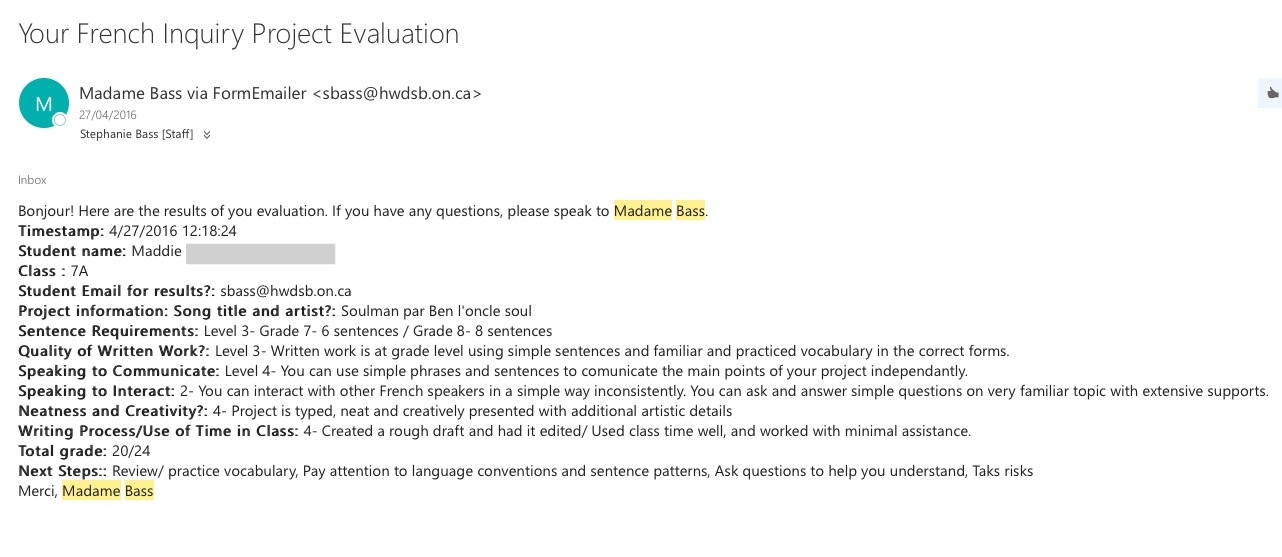
Not only do I have a handy spreadsheet for my grades, but the feedback has been handed back promptly.  My students were able to look at my feedback on their phones.  On their end, their feedback looked like this:


Students get all my notes and their grade as a fraction, as well as a message for their next steps.  My students did appreciate getting their feedback right away.  I like that they get the feedback while their work is fresh in their minds.  

*****************

So there it is- Our latest Inquiry project from start to finish.  I'm sure that there are parts of these posts that may be unclear- or that I have overlooked, so please feel free to ask questions in the comments!  Hopefully I was able to demystify the process of this type of learning in FSL class.  

If you are interested in seeing a shorter Inquiry activity in FSL, click here.  Want the basics? Click here.


Tuesday, 24 May 2016

Guided Inquiry Project: Using Music to Learn French- Part 2 (Research and Writing)


Bienvenue to part 2 of my mini-series on Guided Inquiry for FSL- this project was focused on music. I wanted to write these posts to show how I developed and lead an inquiry exercise in FSL class.  After I spoke at the Spring OMLTA conference about inquiry in FSL classes, and the concerns that many teachers have, I got a few questions about how I lead inquiry for students in their second language.  So I thought that posting exactly how I use inquiry would be useful to teachers who are interested in learning more, and wanted to peek as to how I have done them.

Before I taught French, I laugh enrichment for grade 4 students in 2010, and we completed a term-long inquiry for geography, language and math about creating an environmentally friendly community that resulted in creating a green roof at our school in downtown Toronto.  That was the first inquiry-based learning I lead.  Disclaimer: I do like this approach.  I think that project-based learning is a great strategy or method to get kids making connections and thinking different ways; its not the only thing we can do in FSL class but it is useful to get kids invested in their own language learning.

**************

Alright, onto part 2- how to get the students to research and write in the target language during their inquiry.  I will outline some strategies for getting the student to research in French, manage the class, and guide students writing in preparation for the sharing stage of the inquiry.

After developing the criteria with the class, students break off and work on their own to research different songs.  They choose the songs on which they want to focus based on taste, the criteria and their abilities.  There is differentiation built into this activity, because students choose what they can handle in terms of comprehension.  As this is a guided inquiry, students are guided in where they look for their music.

For this, I had to do a little leg-work before my students took over.  I did an internet search for blog posts that suggested music and songs for helping people learn French.  There are many posts about using music; all the posts I found said that pop music was a great strategy for language learning.  What was not the same in each post, was which songs were the best for FSL learning.  Every blog post I found had a different list of songs and strategies.  This was great for purposes of our inquiry-- we were looking for the best song.  To help the students start their search, I printed lists of URLs and QR codes for students to search and read some blog posts, and listen to examples of songs.


Students were also able to visit my YouTube channel, where I have playlists of French music videos that we have listened to in class, or that I had found online.  Students also could look at my Twitter (available on my class blog) where I retweeted a new song everyday from Tweeter Étudier le français.

In a guided inquiry, the teacher should provide guidance in the focus of the study, as well as the resources used for study.  This is especially important in FSL as students are expected to research in French.  For this project, students looked at both English and French sources, but all the songs they listened to were French.  Some of the sites that students explored were:


Once students found a song that they wanted to focus on, they signed up for the song using a Google form.  Then all the song choices were organized onto a neat spreadsheet for me to refer to.

For students to organize their research, they were given a project booklet to guide their research and writing.  (Click the link for the document.) Here are the guiding questions students followed:


Students used this page to focus their writing in French.  Since they were going to share their information in conversation, they were not expected to write too much,  just a short presentation to give a little information to their audience, after which they would answer questions.

********************

My next blog post in this series will look at how the students shared the information they wrote about their songs, as well as how I assessed their reports and presentations.  If you would like to find all the documents that I created for this activity,  click here.


Wednesday, 18 May 2016

Guided Inquiry Project: Using Music to learn French- Part 1 (Provocation and Criteria)

I have probably said before that I use a lot of pop music in my FSL classes.  Because I do.  We have "mercredi musicale" once a week where we watch a music video in French and complete a short warm-u activity connected to that song.

So when I came across this blog post on FluentU:


I thought it would be a neat thing to try out in class.  This blog post has some great ideas on how to use French pop music as a learning tool for language studies.  

This blog post breaks down a simple method for incorporating music into you language study:
  1. Choose this right kind of songs.  The author notes that he likes rap-- but that French rap was not the best choice for learning.  The rhymes were to fast, which made listening for understanding difficult.  He notes listening to a song, and if you can't make out any words, that song is too difficult for you.  For my students, I made it even easier to choose songs- I adapted a reading strategy from when I taught grade 4; students listen to a verse and a chorus and if there was more than 10 words that they didn't know or recognize that song was too difficult to use as a learning tool.
  2. The blog post outlines a few methods for using music as a learning tool.  The most important method according to the blog post is repetition is the key for successful learning using music.  
  3. Last, the blog post recommends that you like the songs you choose!  If you have to listen to the songs over and over, it shouldn't be a chore.  
The post also includes a list of 7 songs that helped the author with his French along with an explanation as to why these songs were helpful.

I thought that this was a cool idea, so as a class we read this blog post without the song suggestions.  As a class we talked about why pop music would be a great learning tool for FSL students.  Students created graffiti charts with reasons why music could help one learn a language.  Unfortunately, I don't have any pictures of that activity-- but the students came up with some great reasons:
  • Good for listening for comprehension skills
  • Can learn slang to sound more like a natural speaker
  • learn about the French culture through the videos
  • Fun
  • more likely to listen to it over and over
  • tunes and words get stuck in your head
Because this blog post generated some great discussion, I thought it would be a neat inquiry project.  And that's how inquiry projects are born!  This activity was like a provocation-- it got the students thinking about music as more than solely an entertainment medium, and more as a piece of culture, and learning tool.  

The next step was to have the students think about our question:  Quelle est la meilleure chanson d'apprendre le français?  

This question is broad and unanswerable on purpose.  Students have to think of criteria of what makes a song useful for learning about another language; they have choose a song based on that criteria; and then they have to defend their choice of song.  Having to create, follow and defend criteria is HOT skills, and therefore an inquiry project.  

Our first class activity was to create the criteria on which we would base our choices.


We had a brain-storming session as a class, and the students copied notes into their own books as we discussed the criteria.  Students used a lot of circumlocution to come up with their ideas, but in the end, they were happy with the list of criteria we created.  For a copy of this worksheet (.doc) click here. 

This criteria gave students a framework from which to find a song that would be a good tool for FSL students.  The criteria also gave the students somewhere from which to create a defence for their choice.

 To be continued in part 2!


*********************************************************************************

My next blog post in this series will look at how the students researched and found their songs, as well as how they recorded the information they found, and how they created their reports and presentations.  If you would like to find all the documents that I created for this activity,  click here.


Inquiry Activity: French Pop Music and French Language Learning


Phew!  What a term!  I know that it has been a long time between my blog posts, but I have been working on a HUGE project with my students that has taken a couple months- but it was worth it!

So I am breaking up my post on these projects into 3 parts: a blog mini-series of sort.  I'm going to go through the steps of our pop music inquiry project starting with the provocation activity in part one; the development and complete of the project in part 2; and the sharing of the work in part 3.

I will make sure to share any documents that I made and used to complete the inquiry project.  If you use them, please let me know, I love feedback!


Monday, 14 March 2016

Listening Activity: Lyrics Sort (Où vont les paroles?)

Our focus in class lately is "Pop Culture;" that is we have been talking about and looking at movies, music and culture (dance, art, etc.)  It has been very interesting and engaging for the students!  They have been able to talk about their preferences and opinions in French!  One thing that I noticed we were not doing as often was dedicated, and explicit listening activities.  Music is a great tool with which to do dedicated listening activities!

To continue our look (or listen) to "Soulman" by Ben L'Oncle Soul, I have my students complete 2 listening activities "Comment va la chanson?"
To prepare this activity, you will need to print out the lyrics of the song and cut each line into a strip, and mix them up.  You will need strips with lyrics for each group or student

1.  Give the students the strips, and have them read them in groups.  Before playing the song, have them predict how the song will go by placing the strips in certain order.  (I take a picture of the order for comparison later in the activity.

2. Play the song.  Have the student rearrange the strips as the song plays.

3. Compare their prediction to their ordering after they heard the song.  How did it change? (Sometimes I ask the students to try and sing their version of the song.  It gets pretty funny.)


To make this activity a little shorter (for time), I gave each group one verse or the bridge or chorus.  Students had to arrange the lyrics, and then tell me which part in the song it was.  The students were pretty good at listening and arranging the lyrics.  Some of the students arranged them, asked to hear the song a second time, and sang along to make sure it was write.  After students had the lyrics in order, they started trying to figure out the meaning of the lyrics they had while they waited for other groups.

It was a fantastic activity.  We have been working on this song for 3 classes now, and we haven't even started the culture part!  I'm looking forward to what they find out about the singer in our next lesson.

How do you use music in your class?  Want some more ideas for using music in FSL?  I have a post on using pop music in FSL right this way.


Friday, 9 October 2015

Inquiry Activity: Best tools for French Students

 As part of our review this year, I decided to start my 7s and 8s with a small guided inquiry activity.  I thought it would be a good idea to teach students how to use the resources (tech and not) that are available to them, and get their opinions about which ones they found the most useful. 

I provided them with 4 resources, and small lessons on how to use them:

(An old-school, book-style) Dictionary
www.wordreference.com (or the Word Reference App, free!)
Google translate 
Reverso

...and they had to find one more tool to compare and contrast.  The question they had was this:


Trouvez un outil qui est indispensable pour un étudiant de français.  Quel outil est-ce que tu préfères? Pourquoi?

I gave the students a list of words to look up in all the resources.  It was great because they sometimes got conflicting translations, and had to depend on their prior knowledge to make sure that the translations were correct.  They were very frustrated!

They were asked to organize their thoughts about the question for our discussion about the best tool.  It was a great discussion-- many students were disagreeing with each other in French.  I had an anchor chart with discussion promtpt for the student to consult and they used them well.   Overall, Google translate lost in this activity, and the students came to this decision themselves.


What I like best about this inquiry activity is that it is short (about 2-3 classes), it is extremely guided, it focuses on thinking about how students think and therefore what tool would help them best, and it makes students have to persuade and defend their opinon in French.  These are all elements needed for an inquiry activity!  

As a added bonus, students found other resources to use, and which not to use. Here are some others that look good:

http://www.dictionary-fr.com/
http://www.linguee.com/
http://www.lexilogos.com/english/french_dictionary.htm
http://www.alcor.com.au/french_rhyming_dictionary.asp (Not a true dictionary, but cool)
http://lingro.com/dictionary
http://www.littleexplorers.com/languages/Frenchdictionary.html
https://enfr.dict.cc/

I liked this activity.  It was great to refresh students into using the tools they need in French class.  What inquiry-type activities have you tried so far this year?


Friday, 23 January 2015

Les notes visuelles/ Sketchnoting in FSL

Time flies when report cards are due!  I've been trying to keep up with my assessments and marking, and so my blog here has fallen by the wayside for a while.  But I'm back, and I excited to write about my newest hook for my French students!

While I was marking my students' work, I noticed a trend (that I did not like at the time:)


My students are doodlers!  One part of me was disappointed, because I had these great Oral Communication based classes, that I thought were engaging and fun.  Seeing that the students wanted to doodle instead of listen was frustrating.  On the other hand, I thought about why my students doodled-- sometimes it helped them focus their listening.  For others I think it was because they are more visual learners.  So, with this information I wanted to find something that could incorporate art/ drawing into the class in a way that would make their doodling purposeful and effective to their learning.

With research, I found out about Sketchnoting.

I've read about the trend in English speaking classroom using Sketchnoting to help students make notes of things they hear and read.  I've always been a visual note taker-- it helps keep me engaged.  I didn't know that there was a name for it specifically until I saw Mike Rohde's The Sketchnote Handbook.  I bought it, and did some research online, and there were some English literacy teachers that started using it with their students.  (Some helpful articles I found on Sketchnoting for Education are here, here and here.)  Why couldn't this work for my FSL students?  It would be a visual way of taking those dreaded grammar and vocab notes.

While I noticed there were teachers that used Sketchnotes in their lessons, there were not many FSL teachers that did so.  So finding some resources to use in FSL class was difficult.  But, since I'm a visual learner, and a creative-type, I wanted to make some of my own resources.   To introduce the concept to my students, they were to watch the video by Claudine Delfin about Sketchnoting.


Although the video is in English (I couldn't find any French videos), the students got the basics of the purpose and theory behind using visual notes.  For our first lesson, we watched the video, and then had a PCP ( Pensez/Couplez/Partagez) discussion about the important points of the video in French.  As we shared what we thought were the important points, we created our own "note visuelle" about the video.  I created on at the front of the class, and the students were welcome to copy mine, or think of their own imagery to support their points.

As we did the notes, the students were engaged with the discussion and with creating their doodles to support their note.  Some of my most challenged students were creating great notes visuelles:


While students were waiting on the next point during discussion, they added details to their doodles, shared them with each other.


The next class, students were asked to review their notes, and share which points we had already covered, so we could continue the note.  Many students were able to form simple sentences to convey their points from the class before.  More, students commented on how much they enjoyed the process of learning how to make these visual notes.  In order to support the students' learning, and maintain French as the language in FSL class, I created a couple of "notes visuelles" in French.  I photocopied them, and distributed them to the students.  This first handout is based on a page that educator CarolAnne Maguire created in English.  I loved it, so I drew a  French version (Click link for printable version:


Our first grammar based "note visuelles" was a review about our articles:


The above note I used my iPad to create.  For my student that use assistive technology, I was able to teach them how to create their NVs on their devices. 

This is an exciting project that my students and I are doing together.  As I make more resources, I will post them.  And if you start this with your studnets, I would love to know how it goes!

Would you ever try sketchnoting in your FSL class? 

Friday, 31 October 2014

Vlog: How to Kahoot! (Updated with a new idea)


Hi everyone!  Here's a short video that I recorded to show you how easy it is to make a and use Kahoot.

Kahoot is a great web-based program to enhance student leaning.  I have used it as an assessment tool, and as a review tool.  Students really enjoy the game aspect of the activity, and there are a number of tools that educators may find useful.  As an assessment tool: I have used Kahoot as an assessment of learning, and as assessment as learning.

Assessment of Learning:  Kahoot's quiz game is a great and interactive trivia-style question and answer game.  Students sign in, read the question and answer.  Because points are awarded, students don't readily share the answers (in my experience).  During the game, students get real time feedback about why their answer was right or wrong from you and other students.  After the game, Kahoot has an option to download the results of the game into an Excel spreadsheet.  The information included on the spreadsheet is the student's name, the number of questions they answered correctly, the number of questions they answered incorrectly, and each response for the questions.  This can be printed and saved in your gradebook.  As a class, we like to look at the results together and talk about why we answered the way we did.  A great tool for enforcing metacognitive strategies.

Assessment as Learning:  My students are working on a project in which they create their own Kahoot quizzes for the class.  Students must write and assess various questions for their quiz, they must demonstrate understanding by adding pictures or videos for each question, and then they must present the game to the class for them to play.  As a group, we assess the efficacy of their quiz as a study tool for our theme using a class-created criteria.  From the student generated questions, students practice the material repeatedly, but in different and interesting and engaging ways.  

In order to make Kahoot work in your class, each student needs access to a tech device that connects to the internet.  I teach intermediate, so many of my students have cell phones, so that's what we use.  I have played Kahoot in a computer lab as well, and it was effective.

My students love playing Kahoot.  I can't keep them in their seats.
I really love Kahoot for French class.  The students are engaged, and actively reading and discussing the questions in French.  I hope that you try it. Please tell me if you do!

How else could Kahoot be used in the FSL classroom?

**********************************************************************************

UPDATE: One of my co-workers had a really great idea about using Kahoot for a listening comprehension quiz using video.  I thought the questions was great, so here it is with my response:

Question: 
Hi Stephanie,

Thanks for posting this video. I've started using Plickers which is a similar quiz/survey type app. The students really enjoy it and it's been a fun way to do a quick assessment.

What I really like about Kahoot however is the feature of being able to include pictures or even video. From your video it seemed like you are able to display a video before the quiz begins. If that's possible, I'm thinking it could be perfect as an oral comprehension quiz. I can have the students watch a video and then answer a series of questions. Can you let me know if that's possible.

Thanks, DS

  
Response:
It is possible to do that... But. The video is obscured by the prep information for logging onto kahoot. So the students would really have to listen well. But the video plays over and over until you start the game, so students would get amp,e time to listen and sign on. The only other thing is that the video must be on youtube to add it to the game. So you would have to upload it there if you got it from somewhere else.

Within the game, you can add videos before questions as examples or supports, but, it is still in the early beta of testing, and can be slow, or the video can chunk in and out. I've used video in the game twice and once it was flawless, the other time it kicked some of my students out. The second time I may have used too many videos. So there are a few options to use it for listening comprehension. What I usually do is watch the video outside of Kahoot, and then add clips to support while students are playing. Hope this helps! I'm going to add this discussion onto my blog, because that was a great question! Thanks,
DS! 


(**These opinions are my own, and Kahoot has not paid me to be their cheerleader.  I just really love their program!)

Thursday, 13 March 2014

Using the Inquiry Model in a Core French Class

This week during our staff meeting our team was introduced to the Student Inquiry Model.  I was very interested in this topic, as I have seen it used (and used it myself with my gifted class.)  I was wondering how this framework could be used in a Core FSL class, especially since my students have a very limited use of French. 

http://www.edu.gov.on.ca/eng/literacynumeracy/inspire/research/CBS_StudentInquiry.pdf
Click here for the full document.
The student inquiry model is heavily focused around talking; teachers are expected to give students opportunities to share their learning in very step of the project.  Students are asked to revisit steps when new information surfaces, and they are expected to demonstrate their learnings in new ways.  If you are interested in some more information about this model, the MOE has a great monograph (October 2011, ISSN: 1913 8490 or French version click here) as an introduction for the model.  

I had some reservations about trying this in my FSL classroom.  My concerns were similar to a lot of Core French teachers: do my students know enough of the language to make this activity useful? Will they be engaged in another language?  Will they be successful?  Can they stay focused while researching in French?  Will they understand the materials they find?  I thought the best way to solve these issues would be to work through it.  So I tried an inquiry activity with my Grade 5 Core French class. 

Step 1: Setting the Focus

In order to set up an Inquiry activity for my students, I went to the MOE monograph and looked at the parts that could specifically be applied to Core FSL.  In the first step a topic of inquiry has to be chosen.  In order to peak my students curiosity, I created some interest in my classes prior to the inquiry.  I picked the students up from their lines and brought them into the school while wearing a very fancy mask.  When they got into the classroom, I had some music playing ("Beau's Mardi Gras" from the album Mardi Gras in New Orleans by Rounder Records).  They students wanted to know what was going on.  I refused to answer any questions until our entry routines were finished.  


Even thought I chose the focus, the students were interested in what was going on.  I told them it was a special day-- it was Mardi Gras.  Living in Canada, students had little prior knowledge about the event, so I had to provide some.  An important sidebar:  Teaching in the inner city, my students have very different experiences, and sometimes do no process the prior knowledge for some of our lessons.  In these cases, its important to make the experiences for them, and to provide them with some prior knowledge.  I brought my own mask and some beads from the last time I was at Mardi Gras in New Orleans.  Additionally, I showed the students some pictures, and we answered some basic prompted in French:  Qu'est-ce que tu vois?; Qu'est-ce qu'il passe? The students were able to point out the items they recognized in French, and answer the questions simply.  One of my students saw a disco ball, and commented that there was "un ballon de disco a l'image." 

After the picture activity, the students were interested in why such a big party occurred. Using a simple information log, we wrote down what we knew/saw and what questions we had.  Students had some great questions that they could state simply.  They asked, "Pourquoi la fete s'appelle 'Mardi Gras'?"; and "Ou est Mardi Gras?"  I added one question, "Pourquoi est-ce que nous étudions cette fête à la classe de français?"  


Step 2: "Explore"

Next was the "explore" step.  This was the step that I was most anxious about.  In order to prepare students for "recherche" we had a crash course on French website terminology, and we discussed which of our comprehension strategies would be best for this activity.  I also only allowed students to use the websites that I listed for research.  I wanted to make sure that they were not only looking at French websites, but I wanted them to be successful, so I had made sure that there was information on the sites I chose.  

In order for the students to be successful, I searched for some helpful French  sites to guide the students in their research  I posted the websites on the Smart board, and had them in a Nearpod lesson for my students who needed more support.  The main sites that the students used were:

Students were tasked with answering the questions we came up with.  After they did that, they were able to add any additional information that they thought was interesting.  They added this information to their graphic organizer.  To differentiate this part, some groups were tasked with finding "mots amis" or cognates in their searches-- they were still able to find information about Mardi Gras, but they were only focused on using one of the strategies.  This was less overwhelming for some of my students with more challenges.  The differentiate in the other direction, students were allowed to search Wikipedia.fr for additional information or connections.  

Step 3: Analysis

The analysis step was built into our first two steps:  What I wanted them to find out was what does Mardi Gras have to do with French class?  Many students found the Cajun influence in the festival.  Which is a great frist step.  I found that I had to lead them with questions like, "Who were the Cajuns?" And, "Why are they in the United States?" Making these connections was difficult for some of the students.  And we will have to revisit our answers again in another class.

Step 4: Share Learning


To share our learning, we held a "knowledge congress."  We sat in our groups, and each group was expected to share their findings. During the first congress, there was not much to share.  Students had only found answers to the first questions about the name Mardi Gras and the reason for the party. As a class, we decided that we needed to do more research, and so we went back to the "Explore" step.  Which was were we were at March Break.  We are not finished, and I think this is a project that will be ongoing.  I think that students enjoyed this-- they would come up to me and share what they found.

Reflections:

I worried about doing this because I was sure that the students wouldn't focus, or understand.  In reality, they did have difficulties but the challenge was manageable.  I had to keep reminding them to use their strategies, and to look for keywords, like they would if they were searching in English.  It was a great activity in getting the students to make connections to the literacy strategies they use in English, and how helpful they were in French class.  At one point a students was complaining to me and I asked her, "what did I say yesterday?"  She replied, "Stop whining, use my strategies?"  That's right.  And she did.  So that's progress.

I also was not sure what our focus should be, as I spend most of my classes trying to engage students in using our vocabulary, and teaching them how to use/ speak French.  In a meeting, it was suggested to use the lessons on French culture as a springboard into inquiry.  So I thought Mardi Gras was a great entry point as it has the possibility of opening up a great discussion of the Cajuns, and ultimately the Acadian disapora.  

The connection of the Cajuns to the Acadians is a great example of higher-order thinking/ connecting and in line with the curriculum in FSL.  I was especially worried that there wouldn't be that use of higher-order/ critical thinking in this activity as the students have limited French skills.  But, students were finding information and inferring the meaning of things based on the vocab they knew.  They were applying their comprehension strategies, and trying to answer a fairly difficult question in their L2.  Additionally, students had to decide which of the resources they were using were useful and which one's were not.  There were many examples of critical thinking in this activity.

What I was most happy to see were many of my students were working together, and sharing information they found.  It was great to see students helping each other, and wanting to find the answers instead of just finish their work.  As I worked with my more challenged students, we looked at the cognates we collected, and they were able to draw a conclusion from the word they found.  They were able to contribute in the congress, which is exciting.  

To be honest, I wasn't sure if an inquiry activity was going to work in my French class.  But it turned out to be a great learning experience for me and my students.  It is an especially usful strategy for exploring French culture.  I am thinking of some other ways to try and use it in the FSL classroom.  An inquiry  for skills-acquisition? Would that work?  What are some ways that you have infused inquiry into your L2 classroom?  What else can I try?


Saturday, 15 February 2014

Writing Activity: Mon Caractère

Writing activities are usually an ordeal in FSL class.  My students have specific challenges in writing in English, as well as French.  As a result, I find that I have to be very strategic in creating writing activities for my students.

This activity/ project that I came up with was meant to be a bridging activity between the focus questions from our last unit "Je me présente," to our new focus around "Les bandes-dessinées."  Before we started this activity, we learned the third-person singular of the verbs "to be" and "to have."  We learned how to apply the questions of "Je me présente" to other people.

To engage their interest in writing, I thought that it would be fun to create cartoon characters and write about them.  I found these great drawing sheets while browsing Pinterest, and thought they would be perfect to help the kids create their cartoon.

They loved the drawing part.  I encouraged them to create silly characters-- characters that they would want to write about.  Some didn't even use the books.  The example that I created was a Viking-turned-father named "Sven."

I created the example as a way of modelling the writing we were going to do.  I made sure that I followed the Gradual Release of Responsibility model here because writing in French is fairly new to my grade 4s.  We read the paragraph about "Sven," and the students thought it was funny.  We looked at the structure of the paragraph they were to write.  Built into the activity, were questions and prompts to remind the student to write in complete sentences.  I worried about being so rigid, I wanted to students to be creative with their writing, but I wanted them to feel confident that they could write a paragraph in French.

During the modelling part of the lesson, I made sure that the students knew that they would have to bump-up their paragraphs by adding 2-3 original sentences.  We added some to my paragraph together.

For the next step of the activity, we created a paragraph through a shared writing activity.  I drew a  large version of a cartoon on some chart paper, and using the prompts, as a group we wrote the paragraph.  Because my students needed a little extra practice to build their confidence, in small groups we did a second shared writing activity.  Then each group shared their paragraphs.

For the last step, students drew their cartoon and wrote a paragraph about them.  Students really enjoyed this project.  They liked that the drawing books I had made for them helped them draw something they were really proud of.  Their paragraphs were creative, and well written!  And many of my students could write them independently.  I liked that they were working independently in FSL class-- this is a rare occurrence.  Until recently, my students have not had the confidence to complete something without assistance in some way.  I was able to work with small groups of students who were having trouble.

Here are some examples of the work my students created:

To read the paragraphs, click on the image for a larger version.


This was a great writing project for my students.  They were really interested in each others work, and we did several gallery walks after we were finished.  

To add an oral component to it, I'm thinking of having the students interview each other about their characters.  We have a great article which is an interview with a real cartoonist in our books (Acti-Vie 1: Les aventures d'A-V).  We will record the videos on our ipads.  I will let you know how those turn out!


Here are the materials I used for this activity.  I copied 20 drawing booklets for drawing the characters.  I put them in duo-tangs so that we can use them again.