Showing posts with label strategies. Show all posts

Wednesday, 25 May 2016

Guided Inquiry Project: Using Music to Learn French- Part 3 (Sharing and Assessing)


For part 1- Provocation and Criteria,  click here.  
For part 2- Research and Writing, click here. 

For the last part of this blog-series, I will review how the students shared the information they found and how I assessed their projects.  As a bonus, I will include how I provided instant feedback by completing my assessments on an iPad, and then emailed the results to my students.  A major component of the inquiry process is the sharing and communication of the research, as well as any conclusions and further questions.  


To share the students research and work, we had a French Music Expo in our class.  The students were responsible for completing a presentation about their song, and they presented to the FSL students in our school.  


We are a dual track school, so we have French Immersion and Core French students that were happy to come and visit our expo.  I invited the other French teachers to bring their classes when they could accommodate a visit.  For sign-up, I used a Google Doc and table, and had a class sign-up for each block (so that the room would not be too crowded.)  Then throughout the day, each of my classes presented to another class.

I created a form for student visitors to complete:


Students presented and answered questions.  it was great to see the FI students and the Core students interacting in French.  My Core students were nervous about speaking with the FI classes, but they did a great job.  

Assessment- My assessment of this project was 2-fold; one mark for speaking, and one mark for writing.  The rubric the students got at the start of the project was this to guide their written component:


So this was the rubric I used when marking their written copies.  I marked them as the students finished them, the old-fashioned way with a rubric and a pen.

For the oral communication component, I marked the assignments as the expo occurred.  I took my OC rubric, I use the same ones depending on what part of the CEFR I'm focus on, and created a Google form to use as I walked around.  That was I could assess projects on my iPad.


All the components of the rubrics were typed out in the Google Form so all I had to do was check one for each focus.  In the form I added a section for the student's email so that the results would be emailed to the student as I submitted the results to my spreadsheet.


I added a script to my Google Sheet in order to have the students marks email directly to their email addresses.  You can see that my emails have been sent according to my spreadsheet.

There are many add-ons that you can use to do this.  I used Form-emailer which is not available as an add on (directly) anymore.  There are some other straight-forward mail merge programs for sheets though, and some great tutorial videos to guide you!  One great program is Autocrat- available as an add-on.  To add an add-on, click on "Add-ons" in the top menu, and you will get a screen like this:


Browse through and find which add-on will work for you.  Autocrat is the most popular with teachers, and has the most support.  Here's a great tutorial from Amy Mayer to show you how to use the Autocrat Add-on:


(If you want me to do a video on adding scripts to Google Docs, and using FormEmailer and Google sheets, let me know in the comments, and I will create a video tutorial.)  

Not only do I have a handy spreadsheet for my grades, but the feedback has been handed back promptly.  My students were able to look at my feedback on their phones.  On their end, their feedback looked like this:
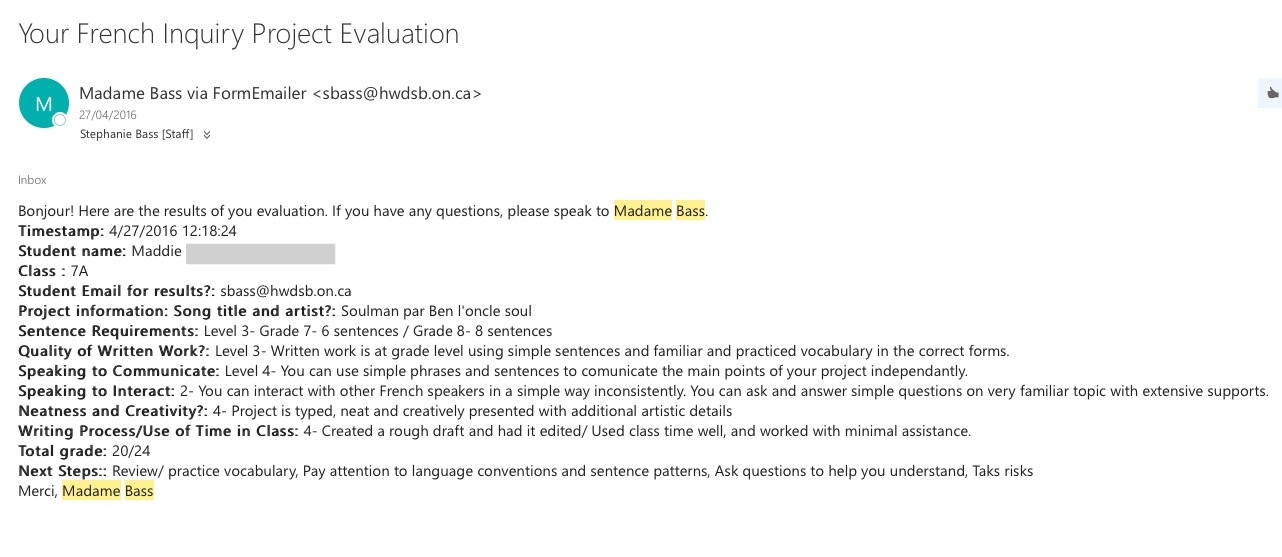

Students get all my notes and their grade as a fraction, as well as a message for their next steps.  My students did appreciate getting their feedback right away.  I like that they get the feedback while their work is fresh in their minds.  

*****************

So there it is- Our latest Inquiry project from start to finish.  I'm sure that there are parts of these posts that may be unclear- or that I have overlooked, so please feel free to ask questions in the comments!  Hopefully I was able to demystify the process of this type of learning in FSL class.  

If you are interested in seeing a shorter Inquiry activity in FSL, click here.  Want the basics? Click here.


Wednesday, 18 May 2016

Guided Inquiry Project: Using Music to learn French- Part 1 (Provocation and Criteria)

I have probably said before that I use a lot of pop music in my FSL classes.  Because I do.  We have "mercredi musicale" once a week where we watch a music video in French and complete a short warm-u activity connected to that song.

So when I came across this blog post on FluentU:


I thought it would be a neat thing to try out in class.  This blog post has some great ideas on how to use French pop music as a learning tool for language studies.  

This blog post breaks down a simple method for incorporating music into you language study:
  1. Choose this right kind of songs.  The author notes that he likes rap-- but that French rap was not the best choice for learning.  The rhymes were to fast, which made listening for understanding difficult.  He notes listening to a song, and if you can't make out any words, that song is too difficult for you.  For my students, I made it even easier to choose songs- I adapted a reading strategy from when I taught grade 4; students listen to a verse and a chorus and if there was more than 10 words that they didn't know or recognize that song was too difficult to use as a learning tool.
  2. The blog post outlines a few methods for using music as a learning tool.  The most important method according to the blog post is repetition is the key for successful learning using music.  
  3. Last, the blog post recommends that you like the songs you choose!  If you have to listen to the songs over and over, it shouldn't be a chore.  
The post also includes a list of 7 songs that helped the author with his French along with an explanation as to why these songs were helpful.

I thought that this was a cool idea, so as a class we read this blog post without the song suggestions.  As a class we talked about why pop music would be a great learning tool for FSL students.  Students created graffiti charts with reasons why music could help one learn a language.  Unfortunately, I don't have any pictures of that activity-- but the students came up with some great reasons:
  • Good for listening for comprehension skills
  • Can learn slang to sound more like a natural speaker
  • learn about the French culture through the videos
  • Fun
  • more likely to listen to it over and over
  • tunes and words get stuck in your head
Because this blog post generated some great discussion, I thought it would be a neat inquiry project.  And that's how inquiry projects are born!  This activity was like a provocation-- it got the students thinking about music as more than solely an entertainment medium, and more as a piece of culture, and learning tool.  

The next step was to have the students think about our question:  Quelle est la meilleure chanson d'apprendre le français?  

This question is broad and unanswerable on purpose.  Students have to think of criteria of what makes a song useful for learning about another language; they have choose a song based on that criteria; and then they have to defend their choice of song.  Having to create, follow and defend criteria is HOT skills, and therefore an inquiry project.  

Our first class activity was to create the criteria on which we would base our choices.


We had a brain-storming session as a class, and the students copied notes into their own books as we discussed the criteria.  Students used a lot of circumlocution to come up with their ideas, but in the end, they were happy with the list of criteria we created.  For a copy of this worksheet (.doc) click here. 

This criteria gave students a framework from which to find a song that would be a good tool for FSL students.  The criteria also gave the students somewhere from which to create a defence for their choice.

 To be continued in part 2!


*********************************************************************************

My next blog post in this series will look at how the students researched and found their songs, as well as how they recorded the information they found, and how they created their reports and presentations.  If you would like to find all the documents that I created for this activity,  click here.


Monday, 14 March 2016

Listening Activity: Lyrics Sort (Où vont les paroles?)

Our focus in class lately is "Pop Culture;" that is we have been talking about and looking at movies, music and culture (dance, art, etc.)  It has been very interesting and engaging for the students!  They have been able to talk about their preferences and opinions in French!  One thing that I noticed we were not doing as often was dedicated, and explicit listening activities.  Music is a great tool with which to do dedicated listening activities!

To continue our look (or listen) to "Soulman" by Ben L'Oncle Soul, I have my students complete 2 listening activities "Comment va la chanson?"
To prepare this activity, you will need to print out the lyrics of the song and cut each line into a strip, and mix them up.  You will need strips with lyrics for each group or student

1.  Give the students the strips, and have them read them in groups.  Before playing the song, have them predict how the song will go by placing the strips in certain order.  (I take a picture of the order for comparison later in the activity.

2. Play the song.  Have the student rearrange the strips as the song plays.

3. Compare their prediction to their ordering after they heard the song.  How did it change? (Sometimes I ask the students to try and sing their version of the song.  It gets pretty funny.)


To make this activity a little shorter (for time), I gave each group one verse or the bridge or chorus.  Students had to arrange the lyrics, and then tell me which part in the song it was.  The students were pretty good at listening and arranging the lyrics.  Some of the students arranged them, asked to hear the song a second time, and sang along to make sure it was write.  After students had the lyrics in order, they started trying to figure out the meaning of the lyrics they had while they waited for other groups.

It was a fantastic activity.  We have been working on this song for 3 classes now, and we haven't even started the culture part!  I'm looking forward to what they find out about the singer in our next lesson.

How do you use music in your class?  Want some more ideas for using music in FSL?  I have a post on using pop music in FSL right this way.


Friday, 23 October 2015

Warm-up/ Review Activity: Décrivez-moi!


Here's a quick activity that I did with my grade 7 and 8 classes, that got them speaking some French to each other, and reviewed adjectives with them too.  I call it "Decrivez-moi!" and it was a lot of fun.  One of my grade 7s actually said at the end of class "Thanks for the fun class today Madame."

It is very simple to set up.  If you want to use my worksheet for adjectives, here's the link

Instructions:

1.  Each students needs a piece of paper and a pencil or marker.  Markers make a pretty sheet, but pencils work fine too.  My students just used their pencils.  Have them sit around a table in groups of 4-6 students.  Smaller groups are less confusing when the activity starts.  They may also need a list of adjectives to consult. 

2. Make sure the students write their name at the bottom of the page, so they can find their page at the end. 

3. Use an interval timer for 30 seconds like this one on YouTube to mark the time for each turn.  When the timer starts, students pass the paper they have to the left.  They will receive a paper on their right.  In the 30 seconds, they must write one adjective that describes the person who's paper they have.

4.  Once the 30 seconds is up, they pass the sheet on, and get a new one to write on. And so on.

5.  When students get their own paper, they can add one, or take a 30 second break to see what others wrote.


I do this activity until each student had at lease 15 adjectives on their page.  About 6 minutes or so.  When the students get their paper back, they are to circle the adjectives with which they agree, and "x" out the ones they don't agree with.

During the activity, students would tell each other "Vite!" and "Changez!" "le cloche va sonner!" and "Passez le papier!" while they were playing. I added an assessment by asking each of the students about the adjectives on their page, and with which they did and didn't agree.  Boom.  Authentic conversations.

If you don't want to use adjectives, I think you could adapt this for other vocabulary review, by having the students work in teams until they have added every word that need to be covered.  Or use it for creative writing in Immersion by having the students write one sentence to create a team story to share with the class.    

What other ways could you adapt this activity?


Friday, 24 July 2015

Vlog: Learning Centre ideas


Bon été! Happy summer! I am having a pretty good summer, but I'm still working hard trying to prepare (as much as one can) for the new school year! I thought that I would make a little vlog about the learning centres I've prepared for the new year. The learning centres that I create are self-contained in folders so they are very portable, and have no set up time. They are handy if you are on a cart. 

Also, I started laminiating my centres so that students can use dry erase markers and then take pictures of their work for their online portfolios. That way I don't have to make copies or worry about wasting paper. They do take a bit of prep for printing and laminating, but I do that at home! So its a pretty cheap way of making sure that I have some great activities that are fun, useful and not just "busy work." 

If you are interested in some of the files I collected to make my centres, please let me know, and I will create a link for you to use the documents I created.

Friday, 8 May 2015

My Classroom Cell Phone Policy


After I led my workshop at WCML this year, I got a few questions about my cell phone policy in class.  I have a fairly strict policy about the use of tech in FSL class.  I have to have such a policy: cell phones are not allowed for personal use in the school, and some of my colleagues aren't completely sold on using cell phones in the classroom.  And I understand their position, they have legit concerns.  My classroom cell phone policy is rigid enough that I hope I cover these concerns, but open enough that the students feel they can use the tech when they need it-- not only when I say they can.

I think its important to say that my practice changes from class to class.   For some classes, I am heavier on the consequences than others.  In others the policy has changed a few times to suit the class I am teaching.  You know your classes-- so you create the policy that works the best for them and their abilities.  So this is a choose your own adventure post.  Choose your class' own tech adventure!

 
The first thing I do is co-create a list of expectations and guidelines for tech use in the classroom.  (We add the sarcastic comments together.)  Students know that they are to use the tech for work only. These guidelines are posted on my cart, and on the screens of the iPads and other tech I use in class.  Not once have I heard, "I didn't know" when I've busted a student.  Sometimes the students quote the blue comments after I recite a rule.


Inevitably, when a student does something they shouldn't with the tech we're using, I have a series of consequences that I choose from depending on the severity of the transgression.
  

Transgression 1: Device not present on the top right corner of desk or table.

This rule was added not too long ago, because students were trying to be sneaky with their tech.  Now, all students know (and habitually place) their cell phones and iPad on the top corner of their desk when they sit down.  If they have a device that I don't see from the beginning of the class, they get a level one consequence.


Transgression 2: Failing a Screen Check.

During any activity, I can say to the class "Les écrans" signalling a screen check from all students.  They must show me their screens without changing anything.  And I know if they have changed anything, because their device will be on the home screen.  If they are honest, it is a level one consequence.  If they are not honest, level 2 consequence. 


Transgression 3: Breaking our Tech-pectations agreements.

Usually its a level 2 consequence because they should know better by now.  

Consequences

My consequences are 2 leveled: Level 1, less serious, level 2 more serious, and usually includes a "heart-to-heart" chat/ lecture with me during their break.

Level 1 If the tech is necessary to complete the classwork, students become my special friends.  They get to sit with me whee I can see their screens, and work there for the rest of the period.  We all know how much teens love sitting right beside the teacher.

 
Level 1 If the tech is not necessary to complete the classwork, students lose their device to the l'oubliette, our lime green cell phone dungeon.  Most of my students are honest if they get caught doing something they shouldn't.  My grade 8s even made a song for times when the oubliette claims another cell phone: (To the tune of "Alouette"- Oubliette/ gentille oubliette./Oubliette/ madame va oublier.) I always forget about the phones in my oubliette. 

Level 2 If the tech is necessary to complete the classwork, students become my "pages." That is, they work for me.  They sit with me for the remainder of the time that it takes to complete the project, a short lecture on "trust" and they get to do my bidding.  They hand out books and sheets, and collect them too.

Level 2 If the tech is not necessary to complete the classwork, student loses device to the oubliette for the remainder of the class.  A chat at break, and an agreement contract.  Time in the oubliette varies too; first time, for the class.  Second time for the day.  Third time, their parents must pick the device up from the office. 

Sometimes, it is necessary to be a little creative with the consequences.  One of my students was consistently going off-task with his phone.  I confiscated it until lunch.  I locked his phone, and emailed the password to his mother.  He could still answer class from people, and make emergency calls, but he couldn't unlock it to do anything else.  I haven't had a problem since them.  Probably won't fall for it again, though.


* Of course, these "transgressions" are not the more serious problems such as looking at inappropriate materials; or cyber bullying or taking pictures/ recordings in class.  These are minor, off-topic, "look at the shiny!" infractions.  For more serious problems, I involve the school administration and follow our internet policies in place. 

My tech policy works well for me.  I know it seems very strict, but it works for my situation as a Core FSL teacher on a cart with students on rotary.  Additionally, I use humor in the enforcement of my policy, so its not as harsh as it may seem.  So far, it has been very effective in managing my classes' use of their own devices in FSL class.  My policy will change as I need it to. 

What is your class room tech policy?  Are you a rotary teacher?  What tips do you have?


Monday, 20 April 2015

Using Pop Music in FSL Class

Image by Phil Fung from http://www.philfungstudio.com/store/catalog/pop-music/

I love Pop Music.  It's not the only type of music I love, but it is a pretty great way of learning a language, about a culture and about a generation.  I owe some of my French speaking skills, and my Spanish speaking skills to Pop Music.  Getting a song or lyric in my head is a great way of learning about pronunciation, and sentences, and um.. rhyming.

So, it can't be surprising that I use a healthy amount of Pop Music in my FSL teaching.  I'm specifying Pop Music here as popular music from around la Francophonie-- stuff that French people would listen to on the radio; or buy the CDs of.  I do believe there is a place for FSL music created for children learning FSL, but I really love the authentic learning about language and culture that happens when listening to and studying a piece of Pop Music from a different country.  So, for the most part, I use Pop Music and not FSL created music in class.

There are a few exceptions: I love Mike Ford's Canadiana Folky Pop Music that is targeted for FSL learners and full of Canadian history that he's researched.  But I still consider that Canadian Pop/ Folk music with a cultural focus.  Besides, he was in Moxy Fruvous, so he is practically a pop star.  (And if you haven't heard his albums Canada Needs You, Vols. 1 & 2, and Seaway you're missing out.) The other exception I make is the stuff I wrote for my students, because that was directly related to their own writing, and more of a product of learning than a tool for learning.

So in order to organize the songs that I have used, and will probably use again in my classes, I created a Google Sheet that lists the songs I've used with their links and notes.  It is available here:


As always, please preview any videos before using in your class.  One video on my list, Paradis ou Enfer would be inappropriate to watch in its entirety in class.  He swears at the end, and flashes the middle finger after 1:23 in the video.  Why did I include it?  I cropped the video to 1:20 using TubeChop to avoid the inappropriate sections, so our class could have a discussion on Sierra Leone.  It has some great visuals about the disparity between the rich and poor in that country. So it was worthwhile to use that video for me.  But, you know the rules and culture of your school.  

So, how would I use all these songs in class?  I use music in a few ways, and I thought I could share a few of those strategies with you!  

1. Where was it filmed?/ Où est-ce que l'artiste?

This is a critical thinking activity that I use in class with a music video.  It usually takes a full class to complete, as students will need to watch the video more than one time to answer the questions.  I have used the video A coup de reves by Ben l'Oncle Soul, and the first 1:20 of Paradis ou Enfer by Kaaris.  
  1. First we read the questions we will have to answer.  they are usually: 1. Où est-ce que la location du clip?  Pourquoi est-ce que tu penses ça?  2. Quelle est la signification du titre ____?  
  2. I have the students watch the video.  
  3. Then we make a word bank of what we saw in the video.
  4. I give students a few minutes to gather their thought about the questions.  Most will ask to watch the video again.
  5. Re-watch the video. Students will point out les indices to help answer the questions.
  6. Then we discuss the questions.  We consult maps or other resources to help us find the answer.
My students love figuring this stuff out.  Because the whole discussion happens in French, it is an authentic way of getting them to communicate with each other in French, and to build a curious community which is necessary for any inquiry-type activities.

2. Gimmie!/ Donnez-moi!

This strategy can be used with any song, and a video is not necessary.  Preparation includes making cards with key words from the song on them, cut out.  You need enough sets of cards for the number of groups you have.  For younger grades, focus on less words, and older grades use more words.
  1. Hand out the cards to each group of students.
  2. Students set the cards out face up between them on a desk or table.
  3. Play the song.  While students listen, the try to grab the words they hear before the other members in their group do.
  4. Player who got the most words wins.
This is a great activity for introducing new vocabulary, and new words of a song.  Sometime, I have the people act out the words they collected to consolidate comprehension.  Its a fun activity.

3. Rhymes/ Les rîmes

To activate students prior learning, especially around vocabulary, this is a great warm-up.  This can be created in a work sheet, or on a chart paper for students to copy or do orally.
  1. Write out the lyrics on a page for each student, or on a chart paper, but omit the words at the end of phrases, or in other places.  The word that is omitted must rhyme with a word in the previous or next line.
  2. Before students listen tot he song, have them predict what words will be in the lyrics, by reading the lyrics, and have students fill in the blanks with the words they think are missing.
  3. Play the songs.  In a different color have the students write in the real words. 
  4. Reflect: How many did they get right? Why did they choose the words they did?
4. Correct this/ Corrigez!

You will need the lyrics posted or copied out for all the students to refer to.  When you write them, replace several of the words in the lyrics with fakes.  This can be as obvious or sneaky as you would like it to be.
  1. With the students, read the lyrics (with the errors your put in) together.  Tell the students that there are some errors in the lyrics.  Have them predict which words don't belong.
  2. Listen to the song.  Have the students write down the correct words for discussion after the song is over.
  3. Discuss which words were wrong.  Did the students know they were wrong? How?
5. How does it go?/ Comment va la chanson?

To prepare this activity, you will need to print out the lyrics of the song and cut each line into a strip, and mix them up.  You will need strips with lyrics for each group or student.
  1. Give the students the strips, and have them read them in groups.  Before playing the song, have them predict how the song will go by placing the strips in certain order.  (I take a picture of the order for comparison later in the activity.)
  2. Play the song.  Have the student rearrange the strips as the song plays.
  3. Compare their prediction to their ordering after they heard the song.  How did it change? (Sometimes I ask the students to try and sing their version of the song.  It gets pretty funny.)
6. Find the picture for the lyrics/ Trouvez l'image des paroles

This activity takes a fair amount of prep.  You will either need to find pictures that go with a song, print out or save stills from a video or movie, or draw simple pictures that reflect lines in the song you are using.  I usually create a sketchnote for the lines, and use those.  You will also need a print out of the lyrics for the students completing the activity.

  1. Review the lyrics with the students to ensure comprehension.
  2. Have the students review the images available for matching.
  3. Listen to the song, and have the student match the images to lines or verses of the song.
  4. After they have matched them, reflect: why did they choose that image for that line?
I have a few more ideas, but I haven't tried them yet.  As I do, I will update this post.  What are some ways you use Pop Music in your FSL class?  

Monday, 9 March 2015

Les notes visuelles/ Sketchnoting in FSL Part 2

As a sort-of bridging unit, my class and I learned a bit about the value of sketchnoting, and how to start the process.  As a class, we found out that sketchnoting is counter to the notetaking we've been taught for most of our education, so we have to learn step-by-step about creating visual notes.


We looked at the major themes in sketchnoting: 5 elements of drawing (les 5 éléments), creating personalized icons (les îcones), containers (les cases), people (les personnes), and structure (la structure). For each section, we had a brief lesson and then a lot of practice using some of the worksheets I created.

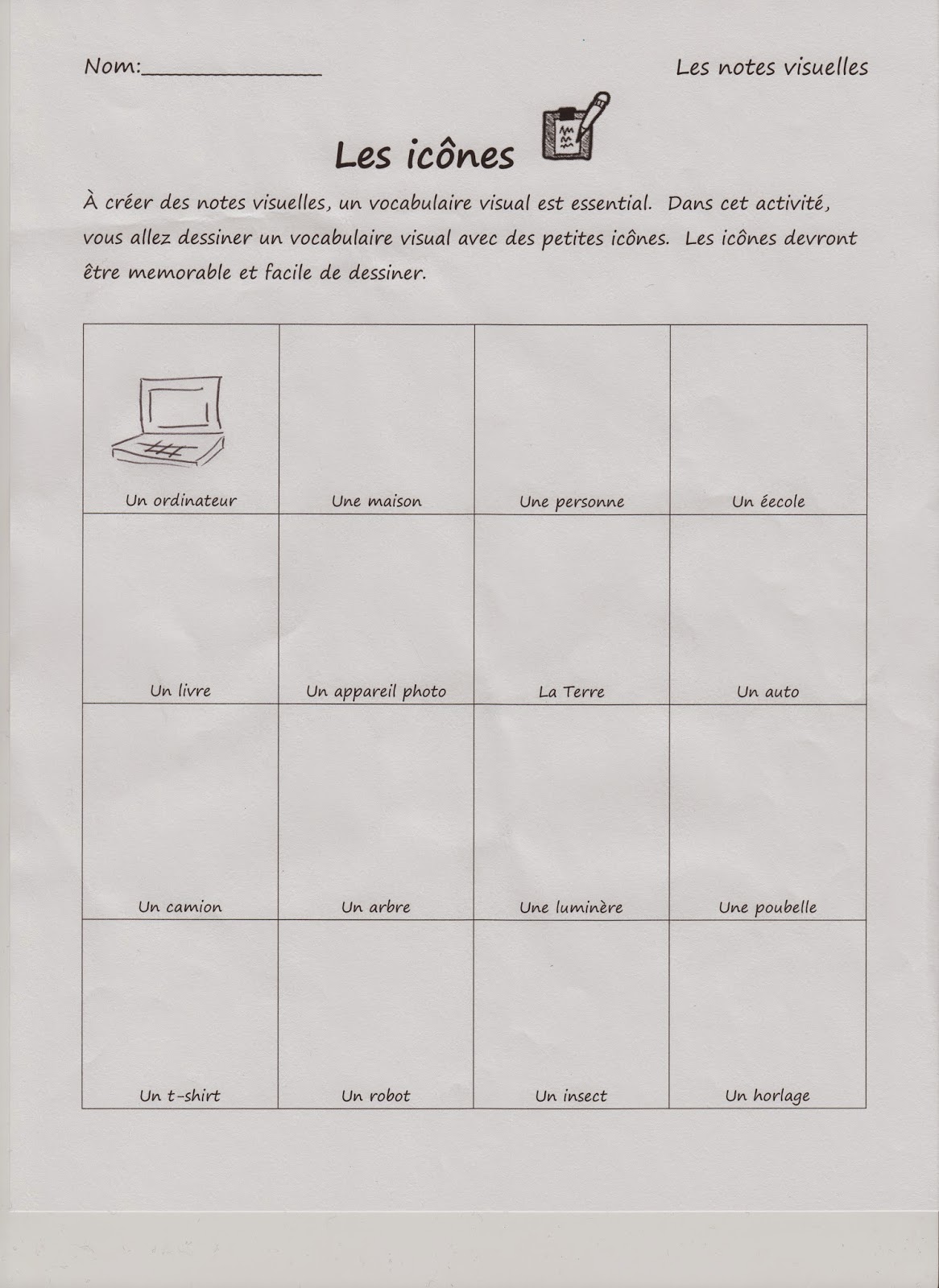
 Here's an example of the worksheet we used to create our personal icons.  What we learned is that sketchnoting is about replacing some parts of our written language with a more visual one.  In order to be successful at that, you need to have a visual vocabulary ready so that those substitutions can happen almost automatically.

To get us started, we created a visual vocabulary for the words and ideas we thought we would use most often.  the goal was to make these icons simple and memorable so that when we heard these specific words, we would recall our icons and use them instead of the words.

To help my students understand what an icon is, and why we would use them, I created a short video for the students to watch about "Les îcones":


Our final activity looked at structure.  I think that this is the most difficult part of sketchnoting.  In order to choose a structure, one has to recognize the patterns in the speakers presentation.  To keep things simple, I taught my students about 7 structures that one can use for any sketchnote without recognizing the structure of the presentation.  For this acticity, students had to either retell their day, or choose a story and retell it through a sketchnote.  Here is the example I made:

 
Students were to use all of the elements of sketchnoting that we learned.   Now that we have moved onto researching about La Francophonie, my students are using sketchnoting to record some of the information they find.  The sidebar we took to explore sketchnoting has been really helpful to my students.  I even use it more in my personal notetaking and found it helps me tackle difficult concepts.  If you are interested in using some of the worksheets I have made, help yourself!

******************************************************************************
Click on the links below to go to a downloadable PDF of each worksheet:


5 éléments worksheet

Les îcones worksheet

Les cases worksheet

Les personnes worksheet

La structure worksheet


Friday, 23 January 2015

Les notes visuelles/ Sketchnoting in FSL

Time flies when report cards are due!  I've been trying to keep up with my assessments and marking, and so my blog here has fallen by the wayside for a while.  But I'm back, and I excited to write about my newest hook for my French students!

While I was marking my students' work, I noticed a trend (that I did not like at the time:)


My students are doodlers!  One part of me was disappointed, because I had these great Oral Communication based classes, that I thought were engaging and fun.  Seeing that the students wanted to doodle instead of listen was frustrating.  On the other hand, I thought about why my students doodled-- sometimes it helped them focus their listening.  For others I think it was because they are more visual learners.  So, with this information I wanted to find something that could incorporate art/ drawing into the class in a way that would make their doodling purposeful and effective to their learning.

With research, I found out about Sketchnoting.

I've read about the trend in English speaking classroom using Sketchnoting to help students make notes of things they hear and read.  I've always been a visual note taker-- it helps keep me engaged.  I didn't know that there was a name for it specifically until I saw Mike Rohde's The Sketchnote Handbook.  I bought it, and did some research online, and there were some English literacy teachers that started using it with their students.  (Some helpful articles I found on Sketchnoting for Education are here, here and here.)  Why couldn't this work for my FSL students?  It would be a visual way of taking those dreaded grammar and vocab notes.

While I noticed there were teachers that used Sketchnotes in their lessons, there were not many FSL teachers that did so.  So finding some resources to use in FSL class was difficult.  But, since I'm a visual learner, and a creative-type, I wanted to make some of my own resources.   To introduce the concept to my students, they were to watch the video by Claudine Delfin about Sketchnoting.


Although the video is in English (I couldn't find any French videos), the students got the basics of the purpose and theory behind using visual notes.  For our first lesson, we watched the video, and then had a PCP ( Pensez/Couplez/Partagez) discussion about the important points of the video in French.  As we shared what we thought were the important points, we created our own "note visuelle" about the video.  I created on at the front of the class, and the students were welcome to copy mine, or think of their own imagery to support their points.

As we did the notes, the students were engaged with the discussion and with creating their doodles to support their note.  Some of my most challenged students were creating great notes visuelles:


While students were waiting on the next point during discussion, they added details to their doodles, shared them with each other.


The next class, students were asked to review their notes, and share which points we had already covered, so we could continue the note.  Many students were able to form simple sentences to convey their points from the class before.  More, students commented on how much they enjoyed the process of learning how to make these visual notes.  In order to support the students' learning, and maintain French as the language in FSL class, I created a couple of "notes visuelles" in French.  I photocopied them, and distributed them to the students.  This first handout is based on a page that educator CarolAnne Maguire created in English.  I loved it, so I drew a  French version (Click link for printable version:


Our first grammar based "note visuelles" was a review about our articles:


The above note I used my iPad to create.  For my student that use assistive technology, I was able to teach them how to create their NVs on their devices. 

This is an exciting project that my students and I are doing together.  As I make more resources, I will post them.  And if you start this with your studnets, I would love to know how it goes!

Would you ever try sketchnoting in your FSL class? 

Monday, 3 November 2014

Kahoot, Part 2: Why I love Kahoot


Here is part 2 of my Kahoot mini-lesson.  I think this web-app has some great uses in the class for assessment of, for and as learning.  Here's how I use this game in FSL class.

Tuesday, 14 October 2014

Do you Lino?


Just a quick post today on an online app that I have been using in class.  Lino is a virtual post-it board that students and teachers can add to from anywhere (provided there is wifi and a device handy.)  Teachers need to create an account for lino, but its free and can link to you google account.  (If you don't have a google account, get one!  Its free and so many apps and programs can link to it.  You don't need 609 names and passwords. )

Lino is a great tool for brainstorming, reflecting and anywhere you would use post it notes.  In the above pic, my classes were using it as a reflection tool and exit activity.  Since I discourage the use of English in class, students can post their exit ticket in English.  Students are encouraged to read other students posts for ideas/ inspiration or to help them create their own reflections.

Lino is great for Inquiry-based activities.  Students can create post-it notes on the information they find and post it to the board for others to see.  The board updates in real time, so students see what is being posted as it happens.  I like to assign colors for each class or group so that I can keep track of who posted what note.


Today we are going to use Lino as a vocabulary collection point for our review on adjectives.  Students will be able to add words and pictures to create a living list of adjectives that they can access.

What I really like about Lino is that I can post the boards to our class blog:

This is the blog zoomed out so that you can see the header and the board.  You can change the size of the Lino board by changing the size settings in your post.
Students then only have to access the class blog to post their notes.  You can embed the lino screen only any website, Lino provides the codes for you to do so.  You can also hotlink to your boards, so if you use Twitter or another messaging platform to communicate with you students, you can add the link there for students to access the Lino boards. Pro-tip: make sure that you set the publicity setting to public, otherwise it will not show the board.  Another pointer, if you are using a mobile device the board will prompt you to download the app, but it is not necessary.  Just click the small "close" x in the top right corner and to will take you right to the board.

Another plus to Lino, is that you do not have to download the app to use the program.  It is accessible through the website www.linoit.com.  As long as students have a browser on their device, they can add to Lino.  The Lino app makes it easier to add to boards, but for creating and editing, I like the online version better.  Its more user-friendly and easier to navigate.

A third positive for Lino is that it keeps all your boards together so that you can look at them later.

This is a handy little app to use in class or outside of class.  I found that some of my students were adding to the Lino boards outside of class time, which is a plus!

What are some ways that you could use Lino in your class?


Thursday, 22 May 2014

Updated "Apps I Use" Page

I have updated the "Apps I use" page with some apps that I have found to be engaging and useful in my FSL classes.  With each entry, I try to give some idea as to how I used this app in my classes.  I love finding new uses for apps, though, so if you have another idea, please share!  I would love to use apps my students are familiar with in new ways.

I have made my list available as a downloadable PDF for sharing.  Just follow this link to access the document.  I will be adding to this list as I create new ideas with new apps, so keep checking back!

Thursday, 3 April 2014

Challenges in Student Engagement in FSL

For me, one of the most difficult things about teaching French in the inner city, is the lack of interest or "buy in" from almost everyone.  I'm sure it differs from school to school, but where I am, French education is just not a priority for everyone involved.  From my collegues, I hear that our students have "other problems" then French.  From the parents, I hear that their kids "can't do French," or that "they will never use French."  From the students I hear, "French is too hard," or "French is boring."  Much of their opinion is based on what they are hearing from the other shareholders.

If you are reading this blog, I don't have to tell you the benefits of learning a second language.  Becasue there are many.

If you are reading this blog, you have probably heard something similar in your area of expertise.  So, the million dollar question is how do you engage students in a subject that may not be valued as much as it shoud?  There are other questions that go along with this, like how do I raise the profile of my subject in my school?  Which is a great question, for another blog post.

We are looking at engagment.  There are many great articles on student engagement.  I spoke a little about engagement  when I wrote about using the Inquiry Model in the FSL classroom, but I wanted to reflect on what I do to ensure student engagment is happening in my class. 

Here's an example, of me getting my students attention.  If you were wondering about the name, I have a moon on my back: clown+lune= clune.  We were thinking about adjectives and nouns, and how to combine them to make titles/ names for our "superheros."  So I dressed up as a caped clown.  You know, a typical Wednesday.

There's a moon on my back if you are wondering about the name.  Clown+Lune= "Clune"

I tend to use a lot of humor in my teaching.  Sometimes throw in a joke to see if the students are listening closely.  At the end of the class, students have a chance to tell me the joke for a stamp on their incentive cards.  Sometimes, I just make sure the lesson is silly itself.  Luckily, I don't need to feel very dignified in my job.  According to author Ruby Kane (from the book Understanding Poverty: A Framework for Teachers), inner-city kids who live in poverty value humor, and the ability to tell an entertaining story.  I see how this works to my advantage, and so I use it.  For example, I was teaching my students how to say/ read our school pledge in French.  I used the echo strategy, but to make it interesting, I really emoted the recitation.  And the studnet had to copy me, so they had to emote as well.  At the end of the reading, one of the student's said, "that was fun.  Can we do it again?" Even the most boring task, can be made interesting in its delievery.  

While I was in teacher's college, I read the book, Teaching Content Outrageously by Stanley Pogrow and I think it completely impacted the way I teach.  I am forutante to be a person with a lot of energy, and a wicked sense of humor (if I do say so myself,) so it made sense that I wanted to be "outrageous" as an instructor.  I know that this method is not for everyone.  Some days, I am too tired to do the whole French class as a happy-fun-time thing.  So I use another strat to get their attention.

I like to problematize my content.  I introduce the class to a problem that I need solving.  Usually one that is grounded in an authentic, real-life situation that the students will encounter. As the culminating task for our "Je me presente" unit, my grade 4 and 5 students had to solve the real life challenge of welcoming a French speaking student from Central Africa into our school.  We had a list of questions to start with:  What would we say?  How will we introduce ourselves? How will we pass along information?  What challenges would we have if we just memorize a bunch of stuff?  What is a better way to prepare so the new student feels welcome?  We also did a little research about the country the student came from.  The students were really engaged because it was a problem, and it was going to be something they would use.  Not may use, but definitely use.  

Lastly, I think that students have a responsibility to be involved in creating their education.  So many of the themes that we cover in my class are student-selected.  For example, my students knew that we were going to look at French literacy/ reading this month, so we had a survey about what type of texts they wanted to read.  They chose comics/ graphic novels and so we started looking at those.  Now our study has started to include superheros, so we looked at costumes and what superheros wear-- which is a cluster of transferable vocubulary.  Even though they chose the topic, I control the lessons, so the students are engaged, but learning what they need to- even if it is a different, albeit fantastic context.  

And even though I use all these strategies, sometimes my lessons fall flat.  So I am always trying something new, and talking to other teachers for ideas.  I like trying new things, it keeps it interesting for me.  Especially because I have to teach the same thing sometimes 3 times a day.  So, if you have some great ideas that you have used in class, please share!  I would be so grateful!

What are some ways that engage your students?  

Thursday, 16 January 2014

Making music for French Class

Students reading my song lyrics to understand the format
I love using music in French class.  The kids love it, and I do too.  Its the one thing that can really get me moving.  My grade 5 classes had completed a short unit on Popular French music.  Some of the songs we discovered are some of the kids' favorites!

Lately, I have been writing my own French songs for the kids to listen to in class.  I wrote one song for our project on Movember; we had some male staff in our school participate this year.  The song was part of a webquest that some students completed.  They loved that song!  For the whole week, they walked around singing "je n'aime pas les moustaches."  They even requested it in their class party!

I thought that I would try again by creating a song for our unit "Je me presente!"  I wanted the song to be simple so that the students would understand it, and so that we could turn it into a writing activity.  Here's what I came up with:


And here is the track sans vocals:


 We started listening to it this week, and we read the lyrics. (Click here to download a PDF of the lyrics.)  The students understood the song very quickly (using their strategies!).  They thought it was funny.  Then I told them that they were going to write their own songs, and they were very anxious.  There were a lot of "I can't"s and "too hards" floating around the place.  The students were adamant that they couldn't.  It was quite frustrating, so we moved onto the next activity.  But I knew that we would revisit the song later.

Today, we listened to the song again, and focused on the structure of the lyrics.  The students noticed that there were many repetitions in the song.  We broke down the song into sections: the chorus, and the verses.  The students were asked to write one verse about themselves.  To help them in their writing, they used their notebooks with all their work from the unit "Je me presente."  Each student had written a lot about themselves already.  They just needed to put it in the right format!

Some student lyrics
 Once they got over their initial fear, they started to write some great lyrics!  They were allowed to used my chorus, and format.  That way it would work when they sang it to the instrumental version of my song.  To get them started, I suggested that they write out the chorus, because its less intimidating than a blank page-- that's what I do.  Many of the students said this helped. And they were writing!  They were talking to each other about song ideas, and trying to find rhyming words for their verses!
It was really exciting for me to see them trying to create their songs.  They were very intimidated about the idea, but as they started, they were adding more ideas.  What we will do is finish our verses, and record our song about our class. 

If you were interested in making your own songs, I will tell you how I made mine.  I use the ipad app Garage Band to make and record songs for class.  Its easy to use, and I can hook up my guitar to it, or use the sounds in the program.  The best way to start is to play around with the app, and find a sound you like.  If you have a friend or child that plays music, they can help too!  I make my husband sing on some of the songs if I need a deep voice.  The resulting song is not bad in quality, or sound.  Its great for class, and you can export the song to other platforms if needed.  For my mustache song, I exported it to Moviemaker, to create a video.
More student's lyrics

If you are not the type to write a song, there are other cool ways to incorporate music and writing into your classroom.  This teacher had his students write the lyrics of the popular song "What does the fox say?" in French.  I had a friend who was in a French children's music group, and they had a contest:  Schools submitted their translations of songs, and then the group recorded it and a video starting the students!  I like to use French Pop music in the activity "Milling to the music" or as we call in in French class, "Marchez a la musique."  Universal France has a great You Tube channel for discovering upbeat modern French music.    
Want to take the plunge and try GarageBand?  This is a great tutorial site if you are interested in trying out the app.  If you make up a song, let me know!  I love finding new french music.  And, as always, you are welcome to use my song in class.  It will fulfill my dream of being a pop star ;-) 

Tuesday, 7 January 2014

"Je suis un voleur"- Fun Oral Strategy

Even though today was really cold, and we didn't have that many students, we had some really good discussions going on!  Today we tried a new strategy to get the students talking in French.  I wanted them to push the limits of what they knew, and get them use the strategies they learned.  We set up the class as a challenge:  Each student was given 3 popsicle sticks.  The goal was to collect as many stick as you can by the end of the class.  Using the questions and words they knew in French, they had to have a conversation with a classmate.  if they spoke any English, they had to give their partner a stick.  If they made an error in answering a question (that their partner noticed) they had to relinquish a stick. 


It was really great to see the students push themselves to communicate in another way than English.  They were using gestures, facial expressions, and other strategies for speaking!  It was wonderful to see one of my fourth graders (who struggles with French class) have his "A-Ha!" moment when he started to read the resources around the classroom.  It was so rewarding to see that he knew where to find the answers to some of the questions asked.

While the students were having their conversations, I was able to work with my strugglers.  It was great to have the time to work with the small group to help reinforce and encourage them.  All the students were on task and trying hard to keep their sticks. 

After the activity, we had a quick discussion (in English) about what challenges they faced; the strategies they used; how they could be more successful in the activity; and what would they change about playing next time.  The class had some really insightful comments about their learning.  One student noted how some of the strategies came "naturally" when they were trying to communicate.  Another student made a great connection to a social issue: she noted that even though she knew some French the activity was challenging.  She connected her experience to that of a New Canadian trying to communicate after immigrating.  So much learning!

If you want to try this activity, here are the instructions: This activity works best when anchored to a specific set of vocab.  We were using some questions from our "Je me presente" unit as a starting point for discussion.  Each student is given a number of sticks (or counters, something that they can trade for the activity.)  In pairs, they start to have a conversation.  I found that the students were really good about "policing" themselves to speak in French.  I often heard, "ah ah ah, en francais!" while the game was going on. 

The goal is to collect all the sticks from your partner.  I gave the students 3 sticks, so when someone collected 6 the game was over.  With my older students, I have them switch partners and play another round. 

I am already thinking of some adaptations to try this again.  Do you have any ideas?  Suggestions?

Monday, 6 January 2014

Les stratégies- Explicitly Teaching Strategies in Class


Click on pic for larger image
I am always looking for ways to improve my students' confidence when it comes to understanding and using French.  Convincing my students to speak in French has been one of my biggest challenges this year!  I explicitly teach/taught/am still teaching some strategies for comprehension, speaking and reading to help my students navigate the many parts of speaking French, and to build their confidence in understanding it. I did not makeup these strategies; I learned them from my mentor.  I thought they were great, and set off using them right away!

Currently in my class, we have been focussing mainly on the "stratégies de comprehension."   I started at the beginning of the year, teaching the first five on the list (Je regarde les image/ I look at the pictures; Je cherche les mots-amis/ I look for cognates; Je cherche les mots-connu/ I look for words I know; Je lis la salle de classe/ I read the classroom; and J'infere/ I infer.)  I added at the beginning of the year  "J'utilise le dictionnaire/ I use the dictionary" because I thought that was an important skill to learn right off the bat.

I think they are great tools.  I have the same pictures and words hanging in my classroom, and in the students' homerooms as well.  I refer to them constantly.  We have used them explicitly in most of our activities.  But, the students still do not use them on their own.  They know all the strategies and what they mean.  And they can use them when I tell them to.  But they are not making the connection to use them on their own.  How do I get them to that level?  This is a new challenge for me.  When I taught these strategies in the past, the students used them frequently and without being told to do so.  My current students do not, which means I need to change something to encourage them to use these strategies.  My goal is for these students to use these tools on their own without my direction.

I found an article on Edutopia about helping students to become "deeper listeners."  This got me thinking about how have I been encouraging my classes to be active listeners. I had not taught active listening explicitly.   When I spoke to my colleagues about this question, they agreed that our classes have a difficult time listening, actively or otherwise.  Active listening hadn't been taught explicitly in their homeroom either; so one strategy I want to try is based around this idea. I would like to use the Think-Pair-Share (Pensez-Partenaires-Partagez ?) strategy in FSL class.  Students would speak about a text they had listened to, collect some information about what they needed to listen for, and how they had understood or misunderstood it.   I would have to prepare some vocabulary for this activity, but I think that it would be valuable to practice active-listening.  This activity would be very short: 3 minutes listening, 3 minutes in partner discussion, and 3 minutes in sharing.  I want it to be short so we can do this activity often.   What activities do you use to encourage active listening?

With this in mind, I believe that I may have to do more work with metacognition in my classes.  This creates a new set of challenges, because speaking about one's own thinking is difficult in one's own language.  How do I encourage students to reflect on their learning when their vocabulary is so limited?   One strategy that I want to use is an "exit ticket" for students to complete at the end of the class that deals specifically with student learning.  I want to give them time to think about their learning process, and the challenges that they may have.  Another strategy that I have used in the past and may fit here, is using sentence stems that help students form their thoughts on metacognition in French.  What do you think?


I don't mind sharing either!  If you would like to print out my strategy cards for your own use, please do!  I have them hanging up in the class, and I carry a set on my cart for traveling purposes.  Click on the link below for a PDF of the comprehension strategy cards.  I hope you find them helpful!

Comprehension Strategy Cards:
https://drive.google.com/file/d/0B11PNgL_hdjrbE81WjhjS1VxeGs/edit?usp=sharing