Wednesday, 25 May 2016

Guided Inquiry Project: Using Music to Learn French- Part 3 (Sharing and Assessing)


For part 1- Provocation and Criteria,  click here.  
For part 2- Research and Writing, click here. 

For the last part of this blog-series, I will review how the students shared the information they found and how I assessed their projects.  As a bonus, I will include how I provided instant feedback by completing my assessments on an iPad, and then emailed the results to my students.  A major component of the inquiry process is the sharing and communication of the research, as well as any conclusions and further questions.  


To share the students research and work, we had a French Music Expo in our class.  The students were responsible for completing a presentation about their song, and they presented to the FSL students in our school.  


We are a dual track school, so we have French Immersion and Core French students that were happy to come and visit our expo.  I invited the other French teachers to bring their classes when they could accommodate a visit.  For sign-up, I used a Google Doc and table, and had a class sign-up for each block (so that the room would not be too crowded.)  Then throughout the day, each of my classes presented to another class.

I created a form for student visitors to complete:


Students presented and answered questions.  it was great to see the FI students and the Core students interacting in French.  My Core students were nervous about speaking with the FI classes, but they did a great job.  

Assessment- My assessment of this project was 2-fold; one mark for speaking, and one mark for writing.  The rubric the students got at the start of the project was this to guide their written component:


So this was the rubric I used when marking their written copies.  I marked them as the students finished them, the old-fashioned way with a rubric and a pen.

For the oral communication component, I marked the assignments as the expo occurred.  I took my OC rubric, I use the same ones depending on what part of the CEFR I'm focus on, and created a Google form to use as I walked around.  That was I could assess projects on my iPad.


All the components of the rubrics were typed out in the Google Form so all I had to do was check one for each focus.  In the form I added a section for the student's email so that the results would be emailed to the student as I submitted the results to my spreadsheet.


I added a script to my Google Sheet in order to have the students marks email directly to their email addresses.  You can see that my emails have been sent according to my spreadsheet.

There are many add-ons that you can use to do this.  I used Form-emailer which is not available as an add on (directly) anymore.  There are some other straight-forward mail merge programs for sheets though, and some great tutorial videos to guide you!  One great program is Autocrat- available as an add-on.  To add an add-on, click on "Add-ons" in the top menu, and you will get a screen like this:


Browse through and find which add-on will work for you.  Autocrat is the most popular with teachers, and has the most support.  Here's a great tutorial from Amy Mayer to show you how to use the Autocrat Add-on:


(If you want me to do a video on adding scripts to Google Docs, and using FormEmailer and Google sheets, let me know in the comments, and I will create a video tutorial.)  

Not only do I have a handy spreadsheet for my grades, but the feedback has been handed back promptly.  My students were able to look at my feedback on their phones.  On their end, their feedback looked like this:
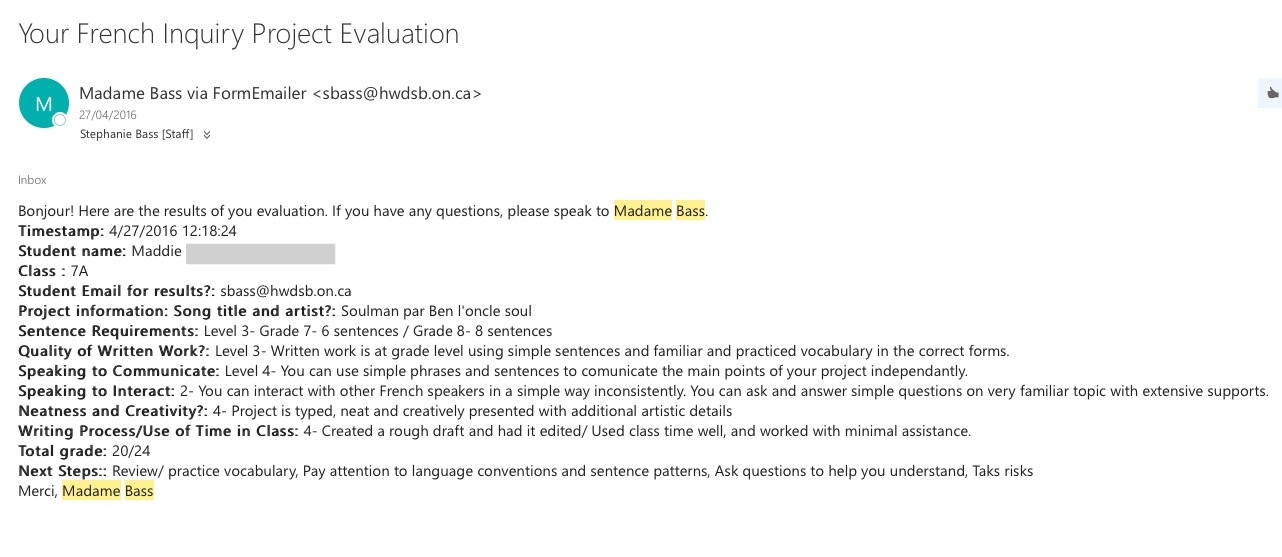

Students get all my notes and their grade as a fraction, as well as a message for their next steps.  My students did appreciate getting their feedback right away.  I like that they get the feedback while their work is fresh in their minds.  

*****************

So there it is- Our latest Inquiry project from start to finish.  I'm sure that there are parts of these posts that may be unclear- or that I have overlooked, so please feel free to ask questions in the comments!  Hopefully I was able to demystify the process of this type of learning in FSL class.  

If you are interested in seeing a shorter Inquiry activity in FSL, click here.  Want the basics? Click here.


Tuesday, 24 May 2016

Guided Inquiry Project: Using Music to Learn French- Part 2 (Research and Writing)


Bienvenue to part 2 of my mini-series on Guided Inquiry for FSL- this project was focused on music. I wanted to write these posts to show how I developed and lead an inquiry exercise in FSL class.  After I spoke at the Spring OMLTA conference about inquiry in FSL classes, and the concerns that many teachers have, I got a few questions about how I lead inquiry for students in their second language.  So I thought that posting exactly how I use inquiry would be useful to teachers who are interested in learning more, and wanted to peek as to how I have done them.

Before I taught French, I laugh enrichment for grade 4 students in 2010, and we completed a term-long inquiry for geography, language and math about creating an environmentally friendly community that resulted in creating a green roof at our school in downtown Toronto.  That was the first inquiry-based learning I lead.  Disclaimer: I do like this approach.  I think that project-based learning is a great strategy or method to get kids making connections and thinking different ways; its not the only thing we can do in FSL class but it is useful to get kids invested in their own language learning.

**************

Alright, onto part 2- how to get the students to research and write in the target language during their inquiry.  I will outline some strategies for getting the student to research in French, manage the class, and guide students writing in preparation for the sharing stage of the inquiry.

After developing the criteria with the class, students break off and work on their own to research different songs.  They choose the songs on which they want to focus based on taste, the criteria and their abilities.  There is differentiation built into this activity, because students choose what they can handle in terms of comprehension.  As this is a guided inquiry, students are guided in where they look for their music.

For this, I had to do a little leg-work before my students took over.  I did an internet search for blog posts that suggested music and songs for helping people learn French.  There are many posts about using music; all the posts I found said that pop music was a great strategy for language learning.  What was not the same in each post, was which songs were the best for FSL learning.  Every blog post I found had a different list of songs and strategies.  This was great for purposes of our inquiry-- we were looking for the best song.  To help the students start their search, I printed lists of URLs and QR codes for students to search and read some blog posts, and listen to examples of songs.


Students were also able to visit my YouTube channel, where I have playlists of French music videos that we have listened to in class, or that I had found online.  Students also could look at my Twitter (available on my class blog) where I retweeted a new song everyday from Tweeter Étudier le français.

In a guided inquiry, the teacher should provide guidance in the focus of the study, as well as the resources used for study.  This is especially important in FSL as students are expected to research in French.  For this project, students looked at both English and French sources, but all the songs they listened to were French.  Some of the sites that students explored were:


Once students found a song that they wanted to focus on, they signed up for the song using a Google form.  Then all the song choices were organized onto a neat spreadsheet for me to refer to.

For students to organize their research, they were given a project booklet to guide their research and writing.  (Click the link for the document.) Here are the guiding questions students followed:


Students used this page to focus their writing in French.  Since they were going to share their information in conversation, they were not expected to write too much,  just a short presentation to give a little information to their audience, after which they would answer questions.

********************

My next blog post in this series will look at how the students shared the information they wrote about their songs, as well as how I assessed their reports and presentations.  If you would like to find all the documents that I created for this activity,  click here.


Wednesday, 18 May 2016

Guided Inquiry Project: Using Music to learn French- Part 1 (Provocation and Criteria)

I have probably said before that I use a lot of pop music in my FSL classes.  Because I do.  We have "mercredi musicale" once a week where we watch a music video in French and complete a short warm-u activity connected to that song.

So when I came across this blog post on FluentU:


I thought it would be a neat thing to try out in class.  This blog post has some great ideas on how to use French pop music as a learning tool for language studies.  

This blog post breaks down a simple method for incorporating music into you language study:
  1. Choose this right kind of songs.  The author notes that he likes rap-- but that French rap was not the best choice for learning.  The rhymes were to fast, which made listening for understanding difficult.  He notes listening to a song, and if you can't make out any words, that song is too difficult for you.  For my students, I made it even easier to choose songs- I adapted a reading strategy from when I taught grade 4; students listen to a verse and a chorus and if there was more than 10 words that they didn't know or recognize that song was too difficult to use as a learning tool.
  2. The blog post outlines a few methods for using music as a learning tool.  The most important method according to the blog post is repetition is the key for successful learning using music.  
  3. Last, the blog post recommends that you like the songs you choose!  If you have to listen to the songs over and over, it shouldn't be a chore.  
The post also includes a list of 7 songs that helped the author with his French along with an explanation as to why these songs were helpful.

I thought that this was a cool idea, so as a class we read this blog post without the song suggestions.  As a class we talked about why pop music would be a great learning tool for FSL students.  Students created graffiti charts with reasons why music could help one learn a language.  Unfortunately, I don't have any pictures of that activity-- but the students came up with some great reasons:
  • Good for listening for comprehension skills
  • Can learn slang to sound more like a natural speaker
  • learn about the French culture through the videos
  • Fun
  • more likely to listen to it over and over
  • tunes and words get stuck in your head
Because this blog post generated some great discussion, I thought it would be a neat inquiry project.  And that's how inquiry projects are born!  This activity was like a provocation-- it got the students thinking about music as more than solely an entertainment medium, and more as a piece of culture, and learning tool.  

The next step was to have the students think about our question:  Quelle est la meilleure chanson d'apprendre le français?  

This question is broad and unanswerable on purpose.  Students have to think of criteria of what makes a song useful for learning about another language; they have choose a song based on that criteria; and then they have to defend their choice of song.  Having to create, follow and defend criteria is HOT skills, and therefore an inquiry project.  

Our first class activity was to create the criteria on which we would base our choices.


We had a brain-storming session as a class, and the students copied notes into their own books as we discussed the criteria.  Students used a lot of circumlocution to come up with their ideas, but in the end, they were happy with the list of criteria we created.  For a copy of this worksheet (.doc) click here. 

This criteria gave students a framework from which to find a song that would be a good tool for FSL students.  The criteria also gave the students somewhere from which to create a defence for their choice.

 To be continued in part 2!


*********************************************************************************

My next blog post in this series will look at how the students researched and found their songs, as well as how they recorded the information they found, and how they created their reports and presentations.  If you would like to find all the documents that I created for this activity,  click here.


Inquiry Activity: French Pop Music and French Language Learning


Phew!  What a term!  I know that it has been a long time between my blog posts, but I have been working on a HUGE project with my students that has taken a couple months- but it was worth it!

So I am breaking up my post on these projects into 3 parts: a blog mini-series of sort.  I'm going to go through the steps of our pop music inquiry project starting with the provocation activity in part one; the development and complete of the project in part 2; and the sharing of the work in part 3.

I will make sure to share any documents that I made and used to complete the inquiry project.  If you use them, please let me know, I love feedback!


Monday, 14 March 2016

Listening Activity: Lyrics Sort (Où vont les paroles?)

Our focus in class lately is "Pop Culture;" that is we have been talking about and looking at movies, music and culture (dance, art, etc.)  It has been very interesting and engaging for the students!  They have been able to talk about their preferences and opinions in French!  One thing that I noticed we were not doing as often was dedicated, and explicit listening activities.  Music is a great tool with which to do dedicated listening activities!

To continue our look (or listen) to "Soulman" by Ben L'Oncle Soul, I have my students complete 2 listening activities "Comment va la chanson?"
To prepare this activity, you will need to print out the lyrics of the song and cut each line into a strip, and mix them up.  You will need strips with lyrics for each group or student

1.  Give the students the strips, and have them read them in groups.  Before playing the song, have them predict how the song will go by placing the strips in certain order.  (I take a picture of the order for comparison later in the activity.

2. Play the song.  Have the student rearrange the strips as the song plays.

3. Compare their prediction to their ordering after they heard the song.  How did it change? (Sometimes I ask the students to try and sing their version of the song.  It gets pretty funny.)


To make this activity a little shorter (for time), I gave each group one verse or the bridge or chorus.  Students had to arrange the lyrics, and then tell me which part in the song it was.  The students were pretty good at listening and arranging the lyrics.  Some of the students arranged them, asked to hear the song a second time, and sang along to make sure it was write.  After students had the lyrics in order, they started trying to figure out the meaning of the lyrics they had while they waited for other groups.

It was a fantastic activity.  We have been working on this song for 3 classes now, and we haven't even started the culture part!  I'm looking forward to what they find out about the singer in our next lesson.

How do you use music in your class?  Want some more ideas for using music in FSL?  I have a post on using pop music in FSL right this way.


Tuesday, 1 March 2016

Using Pop Music to Teach French Culture: Introducing Active Listening

One topic that I notice FSL teachers sometime struggle with is ow to teach culture to their students.  This is one topic that I have challenges with-- because I want to make the subject engaging, but teenagers (I teach intermediates) are rarely interested in a history or culture lesson in French.

One way that I work around that is to teach culture through a format that is understood across all cultures, and that's the idea of music. Music is called the "international" language because all cultures have some form of music.  I especially love teaching FSL student about culture through music because I can look at several different cultures (and countries) that make up the Francophone world, and this opens itself to explorations and discussions about diversity.

In order to use music to teach both FSL Language and Culture, I focus on a set of skills to make sure that my students get the most out of the activities and work we do.  The first skill I teach is that of "Active Listening."  Often when we listen to something or someone, it is a passive activity-- we are doing or concentrating on something else.  For my generation (I was born at the very start of the millennial generation in the 80s), listening as a main activity is not something we have had to do.  We have always had the technology to add visual stimuli to whatever we were listening to.  We have always had TV, movies, computers, video games.  More, we grew up in a fast-paced, high- stressed, over-stimulated environment by having access to the technology.  So for kids who like me had and have an overabundance of stimulus in our world, focusing on one thing is considered "boring," or in actually, very challenging for us.  We need practice and training in this skill-- and using music in FSL is a great way to ensure that students focus on the language of the song-- as well as learn about the culture that the song exists in.

When we start looking at "l'ecoute actif" in class, I often give the students instructions for how to sit and act during a listening activity.  I instruct students to sit in their chairs with both feet flat on the ground in front of them.  I explain that this position is natural and comfortable, and will help them to breathe slowly and fully-- which is essential to making sure you don't fidget and move around-- because then the focus comes off listening and onto moving or someone else moving.

After they are sitting comfortably, I ask them to put their hands on their desk, or in their lap.  Last, I ask them to close their eyes-- We grasp for visuals as young people, and have eyes closed takes away that temptation to look around.

Most importantly, I let the students know that this is a challenging skill to learn.  Our culture here in the "West" does not necessarily value listening in this way, so its something that we have to concentrate on and relearn. During this conversation, on of my students who had gone to school in Beijing, noted that when they had to listen to anything, they were taught to listen in this style-- which was really cool for my students to hear!

Then we listen to the text-- in this case it was "Soulman" by Ben L'Oncle Soul.  They could only listen, no lyrics of video to support their listening this time.  It was interesting to see the challenges some of the students had, and it was interesting to see how well some students could focus their listening.  We listened to the song twice, once "passively" and once "actively" and several students noticed that they could pick out more words than when they were listening to music in the background.

Our next step was to think about what hinders our comprehension of a song in French.  To focus our thinking and conversation.  For this activity I used the "Cadrans de dificultés" from the Curriculum.Org website, which is from the new(ish) document "Listening to Learn."  I linked the short PDF above, because its a really good read with some great ideas!  The handout I made for my students was based on an example from the document.
Students listen to a aural text, and rate the difficulty according to vocal, complexity, pace, accent, point and supports in place.  Then, in the box to the right of the rating, they list strategies to help overcome those challenges.

I love this activity because it has the students listen for understanding, but has them problem solve strategies and potential solutions if the are challenged.  I guided the class as we looked at the first column of the page.  This was a very helpful activity!  It made the students' thinking about strategies explicit, and helped me to see if they knew which strategies to use, and when.

Overall, I think that this was an extremely useful lesson for my students.  Even though they complained about the song at first (as teenagers do), it was the first song they asked to listen to on our musique mercredi.


Friday, 23 October 2015

Warm-up/ Review Activity: Décrivez-moi!


Here's a quick activity that I did with my grade 7 and 8 classes, that got them speaking some French to each other, and reviewed adjectives with them too.  I call it "Decrivez-moi!" and it was a lot of fun.  One of my grade 7s actually said at the end of class "Thanks for the fun class today Madame."

It is very simple to set up.  If you want to use my worksheet for adjectives, here's the link

Instructions:

1.  Each students needs a piece of paper and a pencil or marker.  Markers make a pretty sheet, but pencils work fine too.  My students just used their pencils.  Have them sit around a table in groups of 4-6 students.  Smaller groups are less confusing when the activity starts.  They may also need a list of adjectives to consult. 

2. Make sure the students write their name at the bottom of the page, so they can find their page at the end. 

3. Use an interval timer for 30 seconds like this one on YouTube to mark the time for each turn.  When the timer starts, students pass the paper they have to the left.  They will receive a paper on their right.  In the 30 seconds, they must write one adjective that describes the person who's paper they have.

4.  Once the 30 seconds is up, they pass the sheet on, and get a new one to write on. And so on.

5.  When students get their own paper, they can add one, or take a 30 second break to see what others wrote.


I do this activity until each student had at lease 15 adjectives on their page.  About 6 minutes or so.  When the students get their paper back, they are to circle the adjectives with which they agree, and "x" out the ones they don't agree with.

During the activity, students would tell each other "Vite!" and "Changez!" "le cloche va sonner!" and "Passez le papier!" while they were playing. I added an assessment by asking each of the students about the adjectives on their page, and with which they did and didn't agree.  Boom.  Authentic conversations.

If you don't want to use adjectives, I think you could adapt this for other vocabulary review, by having the students work in teams until they have added every word that need to be covered.  Or use it for creative writing in Immersion by having the students write one sentence to create a team story to share with the class.    

What other ways could you adapt this activity?


Friday, 9 October 2015

Inquiry Activity: Best tools for French Students

 As part of our review this year, I decided to start my 7s and 8s with a small guided inquiry activity.  I thought it would be a good idea to teach students how to use the resources (tech and not) that are available to them, and get their opinions about which ones they found the most useful. 

I provided them with 4 resources, and small lessons on how to use them:

(An old-school, book-style) Dictionary
www.wordreference.com (or the Word Reference App, free!)
Google translate 
Reverso

...and they had to find one more tool to compare and contrast.  The question they had was this:


Trouvez un outil qui est indispensable pour un étudiant de français.  Quel outil est-ce que tu préfères? Pourquoi?

I gave the students a list of words to look up in all the resources.  It was great because they sometimes got conflicting translations, and had to depend on their prior knowledge to make sure that the translations were correct.  They were very frustrated!

They were asked to organize their thoughts about the question for our discussion about the best tool.  It was a great discussion-- many students were disagreeing with each other in French.  I had an anchor chart with discussion promtpt for the student to consult and they used them well.   Overall, Google translate lost in this activity, and the students came to this decision themselves.


What I like best about this inquiry activity is that it is short (about 2-3 classes), it is extremely guided, it focuses on thinking about how students think and therefore what tool would help them best, and it makes students have to persuade and defend their opinon in French.  These are all elements needed for an inquiry activity!  

As a added bonus, students found other resources to use, and which not to use. Here are some others that look good:

http://www.dictionary-fr.com/
http://www.linguee.com/
http://www.lexilogos.com/english/french_dictionary.htm
http://www.alcor.com.au/french_rhyming_dictionary.asp (Not a true dictionary, but cool)
http://lingro.com/dictionary
http://www.littleexplorers.com/languages/Frenchdictionary.html
https://enfr.dict.cc/

I liked this activity.  It was great to refresh students into using the tools they need in French class.  What inquiry-type activities have you tried so far this year?


Tuesday, 22 September 2015

Song: En Classe Je Parle Français- All about that Bass Parody

I have decided, that this year, I want to be the "Weird Al" of French Teachers.

So to kick that off, I wrote some lyrics to go with the song "All About that Bass" that enforce speaking French in class.  Would you like to hear it?


Fun, huh?  I'm teaching in to my classes now, and hopefully they will create a music video in the future for it.  If you want to use it with your classes, feel free!  Here are the lyrics:

If you wanted to sing along to it, you could find a karaoke track on YouTube like this one, but minimize the screen or don't show it, so the students have to use the French lyrics!

If you do use it, and make a totally cool music video, please share it!  I would love to see it!

Monday, 27 July 2015

Book review: Other Cats to Whip: The Book of French Idioms


Summer's a great time to catch up on some reading!  Its also the time that I get to look at new books and resources that come out and think of how I can use them in my class.  This book review is for the book Other Cats to Whip: The Book of French Idioms by Graham Clark and Zubair Arshad.  The book is about 45 pages (closer to 85 in PDF), published by Idiomatic Publishing, Ltd. and was published this year, May 2015.

Other Cats includes over 50 French idioms, and cartoons that accompany the phrases.  Most helpfully, for each idiom, the authors provide an example of how to use the phrases in conversation, as they would be used by native speakers. 

The book is illustrated with funny drawing of the literal meaning of the idioms, like "pulling worms out of someone nose."  I think that these images are memorable, and if I use it with my students, I believe that there are several images that they will remember.  I think that this would lead to them trying to use the idiom that went with the image they connected with.   Since I had read the book, I know that I have use a couple of the idioms, because of the visual memories of the illustrations. 

The best part of this collection, is that all the idioms that are highlighted, seem like turns of phrases that would be useful to know-- that is they readily relate to some English idioms that we use.  Metaphoric language can be difficult for students to understand in their first language, being able to highlight similarities in their L2 would be a great asset in introducing and using more colloquial French including idioms.  Oddly enough, I use a few idioms that were in the book-- the main one being "C'est chouette!"  I say oddly, because I wasn't aware that was an idiom!  Just another symptom of learning French from living in a French country! 

While there were some of the idioms I had heard before, there were others I was not familiar with at all nor were my Franco-friends that were from Southern France and Senegal.  That's doesn't mean they aren't useful, just that I'm not sure how commonly they are utilized.   What I would have liked to see is some explanation of where the idiom is used, how it came to be, which idioms were more common than others... a little more information for the questions I had and I'm sure my students will have.  Also, the illustrations for the idioms are in greyscale, and I would love to see them in full colour. 

One concern I would have reading this to some of my students is a few of the jokes and one of the idioms included a rude word-- "cul" which translates loosely to "ass,"  so that is one idioms I wouldn't read in class.  Also, in the introduction, the author alludes to a rude word in a funny story about how the book came to be.  Probably more appropriate for the high school kids in those two instances.

Overall, I think that this could be a useful resource to bring some of those more authentic pieces to your students conversational skills.  There are a couple of ways that I would use this book in my  class.  If the illustrations were in color, they would be a great display for the wall to encourage me and students to try and use them.  I may have an idiom of the month, and display one page for the month and track students that use it.  Like a type of contest that could bring the use of the idioms to the conversations that we have in class.

Another idea that I had was to use the pages as large flash cards for the idioms.  Each idiom has an illustration, and then on the next page the translation of the important words of the idiom, as well as an example.  This would be a great set of cards to play "J'ai... Qui a..." with.  Students would read the example of the idiom, and the matching card-- the illustration would be the match.  That could be a fun game for the class to read the book together. 

If you are interested in learning more about Other Cats to Whip: The Book of French Idioms visit the book's website http://thebookoffrenchidioms.com/  for a preview and more information on the paperback version; or you can purchase the e-book on Amazon for Kindle.

***********************************************************************************
Disclaimer:  I was provided with a free digital copy of this book in order to write this book review.  The copy was provided to me so that I could write an honest review of the book and its use in the FSL classroom.  I do not receive any monetary compensation for my review of resources, and all opinions and comments are my own. 

Friday, 24 July 2015

Vlog: Learning Centre ideas


Bon été! Happy summer! I am having a pretty good summer, but I'm still working hard trying to prepare (as much as one can) for the new school year! I thought that I would make a little vlog about the learning centres I've prepared for the new year. The learning centres that I create are self-contained in folders so they are very portable, and have no set up time. They are handy if you are on a cart. 

Also, I started laminiating my centres so that students can use dry erase markers and then take pictures of their work for their online portfolios. That way I don't have to make copies or worry about wasting paper. They do take a bit of prep for printing and laminating, but I do that at home! So its a pretty cheap way of making sure that I have some great activities that are fun, useful and not just "busy work." 

If you are interested in some of the files I collected to make my centres, please let me know, and I will create a link for you to use the documents I created.

Friday, 8 May 2015

My Classroom Cell Phone Policy


After I led my workshop at WCML this year, I got a few questions about my cell phone policy in class.  I have a fairly strict policy about the use of tech in FSL class.  I have to have such a policy: cell phones are not allowed for personal use in the school, and some of my colleagues aren't completely sold on using cell phones in the classroom.  And I understand their position, they have legit concerns.  My classroom cell phone policy is rigid enough that I hope I cover these concerns, but open enough that the students feel they can use the tech when they need it-- not only when I say they can.

I think its important to say that my practice changes from class to class.   For some classes, I am heavier on the consequences than others.  In others the policy has changed a few times to suit the class I am teaching.  You know your classes-- so you create the policy that works the best for them and their abilities.  So this is a choose your own adventure post.  Choose your class' own tech adventure!

 
The first thing I do is co-create a list of expectations and guidelines for tech use in the classroom.  (We add the sarcastic comments together.)  Students know that they are to use the tech for work only. These guidelines are posted on my cart, and on the screens of the iPads and other tech I use in class.  Not once have I heard, "I didn't know" when I've busted a student.  Sometimes the students quote the blue comments after I recite a rule.


Inevitably, when a student does something they shouldn't with the tech we're using, I have a series of consequences that I choose from depending on the severity of the transgression.
  

Transgression 1: Device not present on the top right corner of desk or table.

This rule was added not too long ago, because students were trying to be sneaky with their tech.  Now, all students know (and habitually place) their cell phones and iPad on the top corner of their desk when they sit down.  If they have a device that I don't see from the beginning of the class, they get a level one consequence.


Transgression 2: Failing a Screen Check.

During any activity, I can say to the class "Les écrans" signalling a screen check from all students.  They must show me their screens without changing anything.  And I know if they have changed anything, because their device will be on the home screen.  If they are honest, it is a level one consequence.  If they are not honest, level 2 consequence. 


Transgression 3: Breaking our Tech-pectations agreements.

Usually its a level 2 consequence because they should know better by now.  

Consequences

My consequences are 2 leveled: Level 1, less serious, level 2 more serious, and usually includes a "heart-to-heart" chat/ lecture with me during their break.

Level 1 If the tech is necessary to complete the classwork, students become my special friends.  They get to sit with me whee I can see their screens, and work there for the rest of the period.  We all know how much teens love sitting right beside the teacher.

 
Level 1 If the tech is not necessary to complete the classwork, students lose their device to the l'oubliette, our lime green cell phone dungeon.  Most of my students are honest if they get caught doing something they shouldn't.  My grade 8s even made a song for times when the oubliette claims another cell phone: (To the tune of "Alouette"- Oubliette/ gentille oubliette./Oubliette/ madame va oublier.) I always forget about the phones in my oubliette. 

Level 2 If the tech is necessary to complete the classwork, students become my "pages." That is, they work for me.  They sit with me for the remainder of the time that it takes to complete the project, a short lecture on "trust" and they get to do my bidding.  They hand out books and sheets, and collect them too.

Level 2 If the tech is not necessary to complete the classwork, student loses device to the oubliette for the remainder of the class.  A chat at break, and an agreement contract.  Time in the oubliette varies too; first time, for the class.  Second time for the day.  Third time, their parents must pick the device up from the office. 

Sometimes, it is necessary to be a little creative with the consequences.  One of my students was consistently going off-task with his phone.  I confiscated it until lunch.  I locked his phone, and emailed the password to his mother.  He could still answer class from people, and make emergency calls, but he couldn't unlock it to do anything else.  I haven't had a problem since them.  Probably won't fall for it again, though.


* Of course, these "transgressions" are not the more serious problems such as looking at inappropriate materials; or cyber bullying or taking pictures/ recordings in class.  These are minor, off-topic, "look at the shiny!" infractions.  For more serious problems, I involve the school administration and follow our internet policies in place. 

My tech policy works well for me.  I know it seems very strict, but it works for my situation as a Core FSL teacher on a cart with students on rotary.  Additionally, I use humor in the enforcement of my policy, so its not as harsh as it may seem.  So far, it has been very effective in managing my classes' use of their own devices in FSL class.  My policy will change as I need it to. 

What is your class room tech policy?  Are you a rotary teacher?  What tips do you have?